Procedure for Online Document Requisition
Step 1 1, Go to this link: https://dione.batstate-u.edu.ph/odr Step 2 2. Take time to read the reminders. Step 3 3. Click the ‘Next’ button at the lower right portion of the screen. Step 4 4. Choose the Batangas State University Campus where your request will be filed. Step 5 5. Choose the document/s to be requested and enter the number of copies you intend to have. Step 6 6. Fill out the input fields with the required information and click the ‘Next’ button Step 7 7. Draw your signature, tick the confirmation button for the accuracy of the information that you have provided, click the ‘Submit’ button, and click ‘Yes’ for the confirmation of your submission. Step 8 8. Read the information in the ‘Result’ section. Take note of your reference number. On tracking your request: Option 1: Using the same link, you may track the status of your request by clicking the ‘Request Tracker’ button and putting your reference number. Option 2: Check the email that you have provided in the Online Document Request portal. For queries, you may contact Registrar’s Office: registrar.pb@g.batstate-u.edu.ph registrar.alangilan@g.batstate-u.edu.ph registrar.lipa@g.batstate-u.edu.ph registrar.nasugbu@g.batstate-u.edu.ph registrar.malvar@g.batstate-u.edu.ph
Batangas State University partners with University of Wolverhampton for Implementation of DOST – British Council Newton Fund Research Linkages Grant
Batangas State University and University of Wolverhampton, spearheaded by President Tirso A. Ronquillo and Prof. Chaminda Pathirage finally kicked off the activities for the DOST-British Council Newton Fund Grant for Researcher Linkages. The research linkage will be in a form of workshop with the theme: “Developing Smart Environmental Resilience Solutions for Coastal areas in the Philippines: Susceptibility, Adaptation and Mitigation Measures: SEACAP.” This research linkage workshop will convene local stakeholders and academic professionals in developing significant and innovative strategies, technologies and approaches towards environmental resilience of the coastal communities in the Philippines. SEACAP will serve as a platform for both experts from the UK and Philippines to better interpret and adapt environmental resilience in coastal communities as well as understand the culture, practices, needs and limitations in developing coastal resilience. The 5-day scientific workshop aims to gather researchers of various disciplines interested in helping the Philippines become environmentally resilient on disaster and degradation of natural resources. Senior and Early Career Researchers (ECRs), from both the UK and the Philippines, from various disciplines such as environmental and coastal engineering, communication and information systems, big data data, internet of things and built environment are the intended audience. It will help strengthen the capacity of local participants in realizing the relevance of emerging technologies in environmental resilience. It will also provide a good opportunity to develop multidisciplinary approaches for effective environmental resilience management of coastal communities. For further details of this research linkage, you may visit the SEACAP webpage. Reference pages from British Council Website https://www.britishcouncil.ph/programmes/education/newton-agham-programme/grant-awardees/2020 https://www.britishcouncil.ph/about/press/six-female-researchers-lead-years-dost-newton-awards
Batangas State University supports Flexible Learning
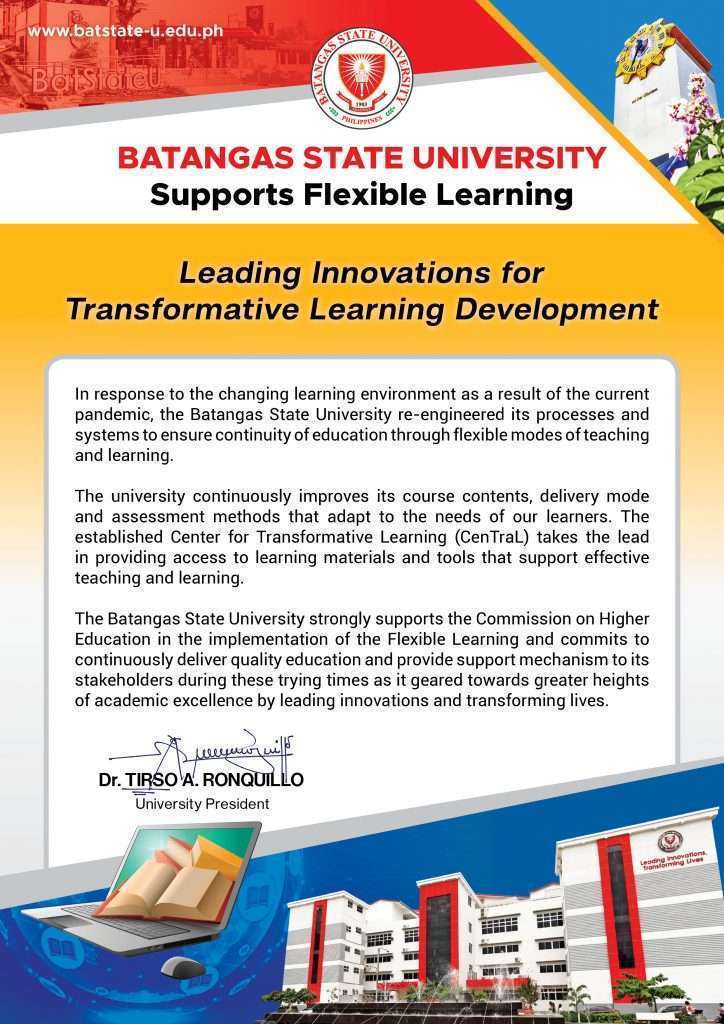
In response to the effects of the COVID-19 pandemic, the University embraced the ‘new norm’ and utilized all available technology and resources to ensure continuous knowledge-sharing between the Red Spartan educators and students. Rising up to the challenge, Batangas State University supports the Commission on Higher Education in the implementation of Flexible Learning, as it positions itself at the forefront of Leading Innovations for Transformative Learning Development. #BatStateUSupportsFlexibleLearning #LeadingInnovations #TransformingLives #ZitoRedSpartans
BatStateU and India’s CMFRI collaborate for research on marine science
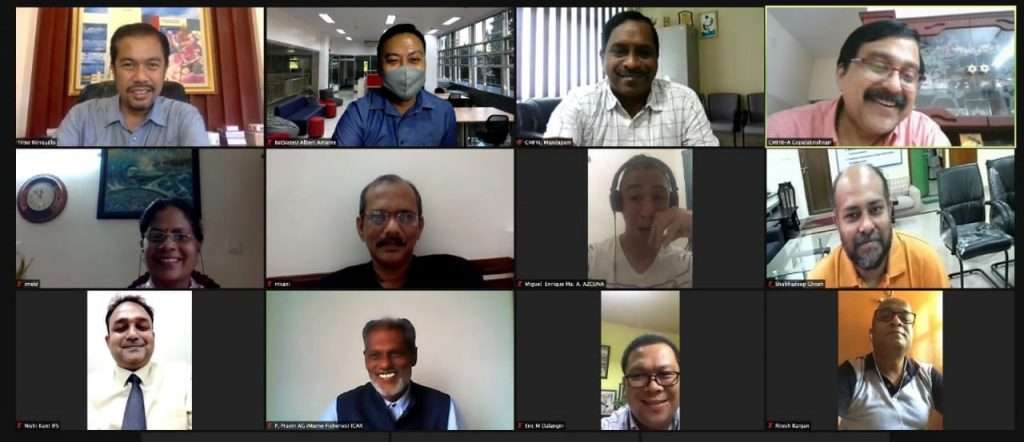
Batangas State University and India’s Central Marine Fisheries Research Institute (CMFRI) formally convened in a virtual meeting as part of the initial scoping discussion for a research collaboration in the field of marine science, May 20. CMFRI is a marine fisheries research institute located in Kerala, India which has emerged as a leading tropical marine fisheries research institute in the world. The institution enjoys the status of a premier research organization which is comparable to any other institution in the developed countries. Specific key areas of collaboration were pointed out during the meeting which include cage culture of fish, seaweed culture, effects of ocean acidification and global warming on marine ecosystems, and use of microalgae cultures to produce fishmeal and bioactive compounds for drug discovery, and other related areas. The new partnership will be forged through a Memorandum of Understanding (MoU) between BatStateU and CMFRI. The MoU will include provision of funds and expertise from the Indian researchers and experts at CMFRI. Meanwhile, a short-term exchange program between researchers from both institutions will also be proposed. The online meeting was attended by BatStateU President Tirso A. Ronquillo, Vice President for Research, Development and Extension Services Engr. Albertson D. Amante, BatStateU ARASOF-Nasugbu Chancellor Dr. Enrico M. Dalangin, VIP CORALS – Nasugbu Head Dr. Miguel Enrique Ma. A. Azcuna, as well as key officials of CMFRI. New horizons await the Philippine-India research cooperation on marine biodiversity. More developments regarding this collaboration is expected to be initiated within the year. Photo source: India in Philippines (Embassy of India, Manila) Facebook page (https://www.facebook.com/IndiaInPhilippines/photos/a.468605903270342/2311234842340763/)
BatStateU Chronicle Special Edition – Bayanihang Red Spartans
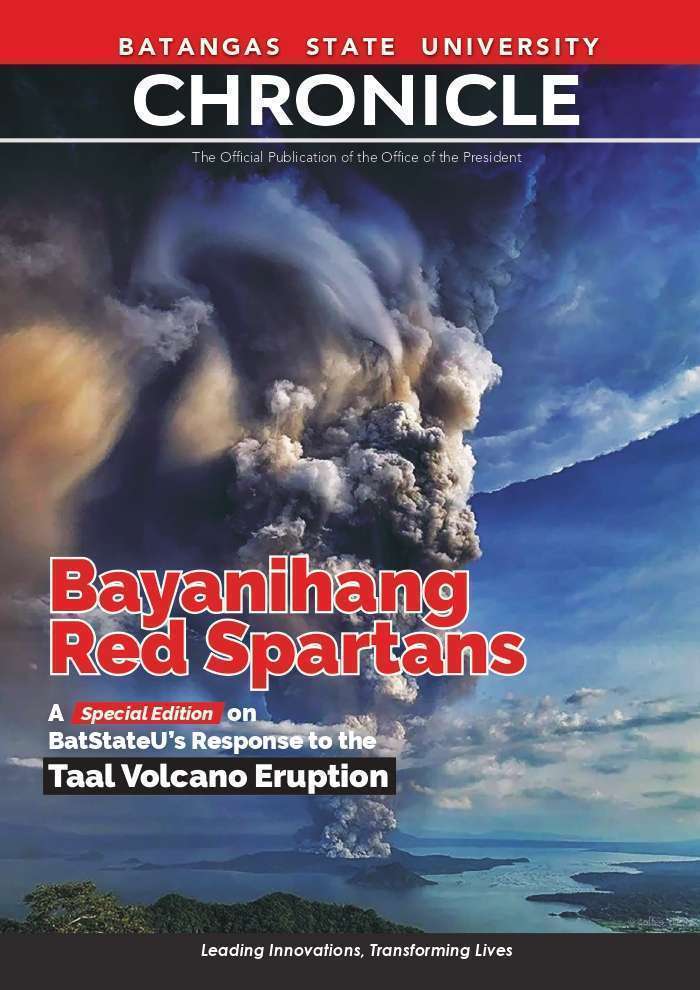
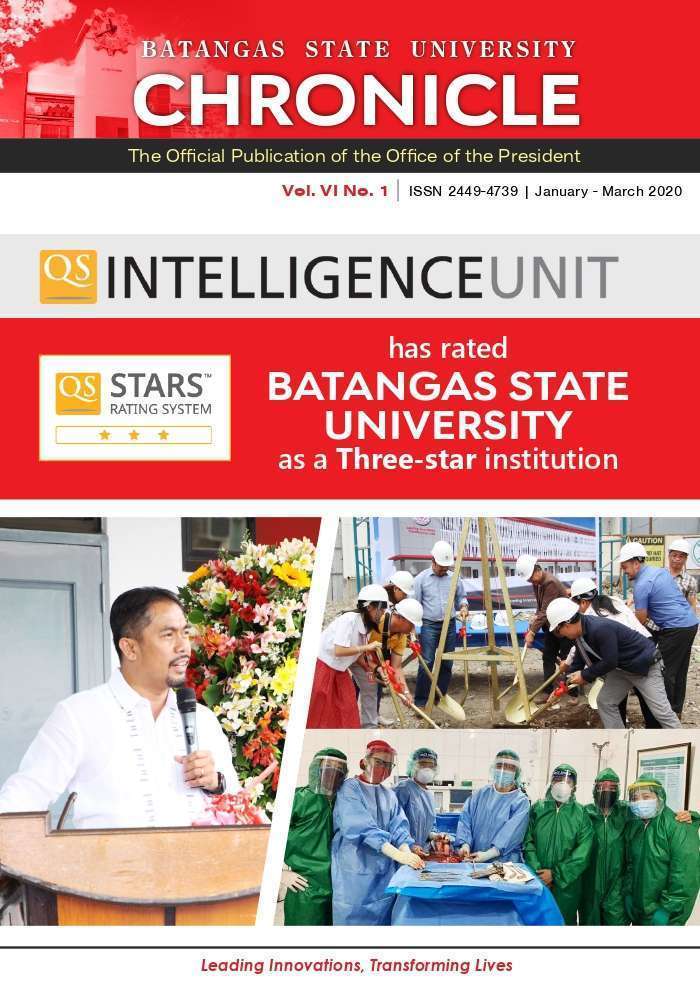
BatStateU Chronicle Vol. VI, No. 1, January – March 2020
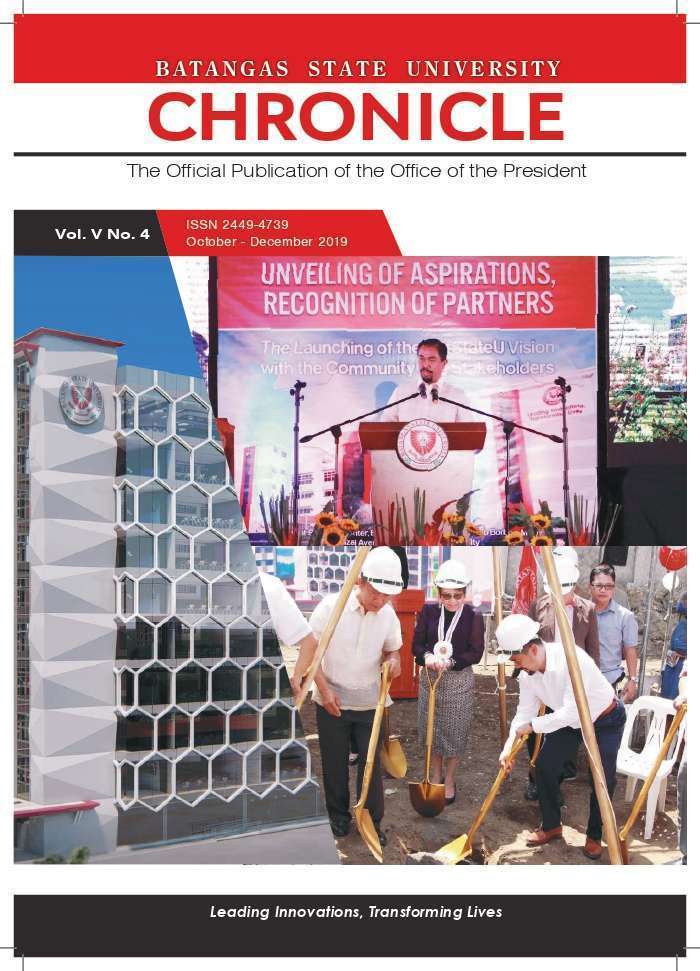
BatStateU Chronicle Vol. V, No. 4, October – December 2019
BatStateU Chronicle Vol. V, No. 3, July – September 2019
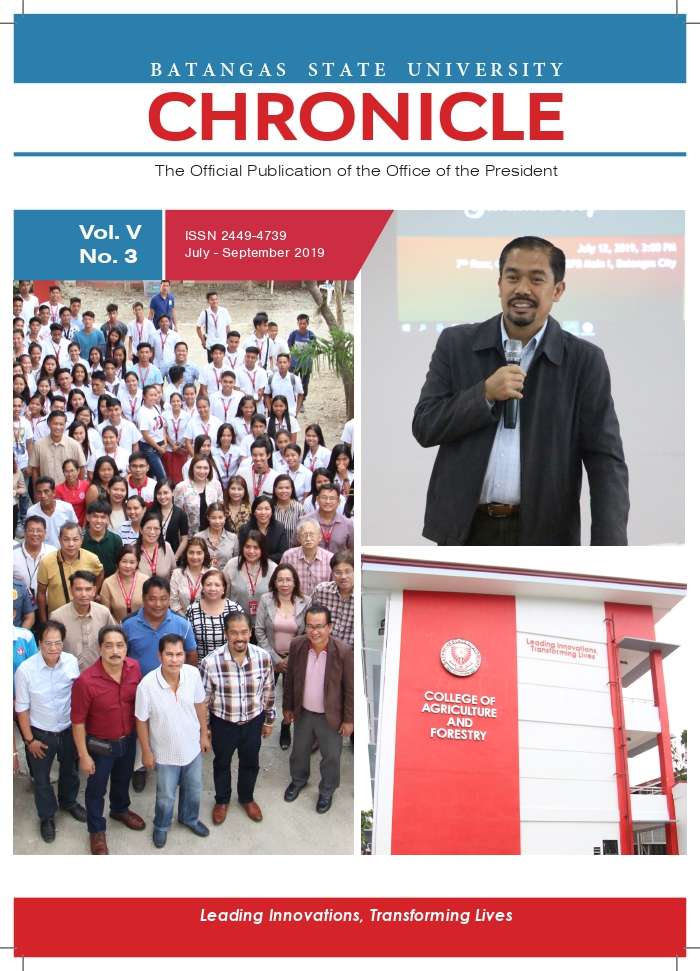
BatStateU Chronicle Vol. V, No. 2, April- June 2019
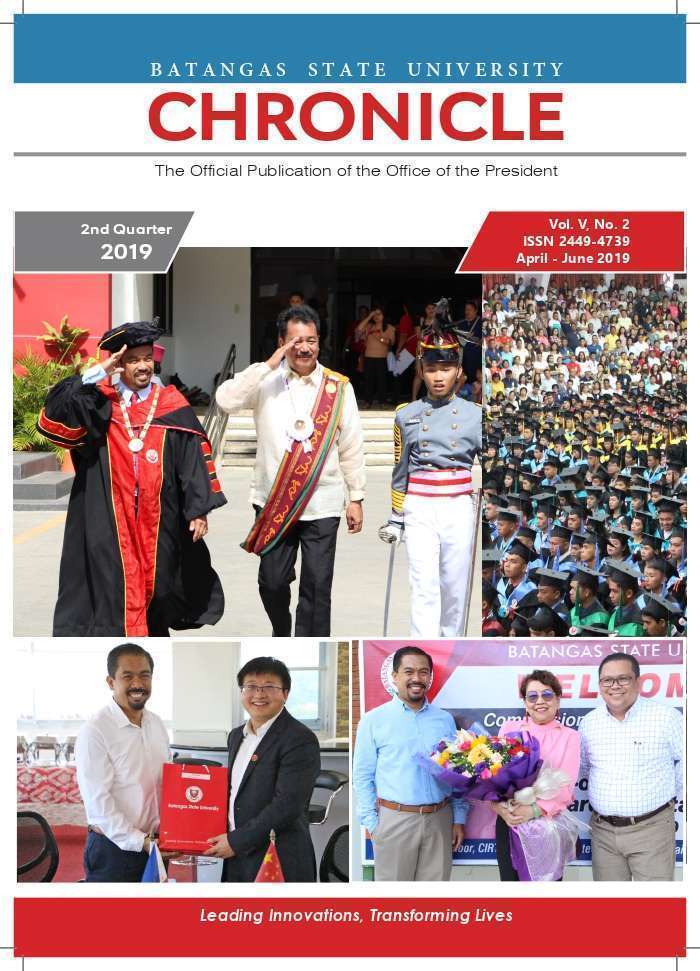
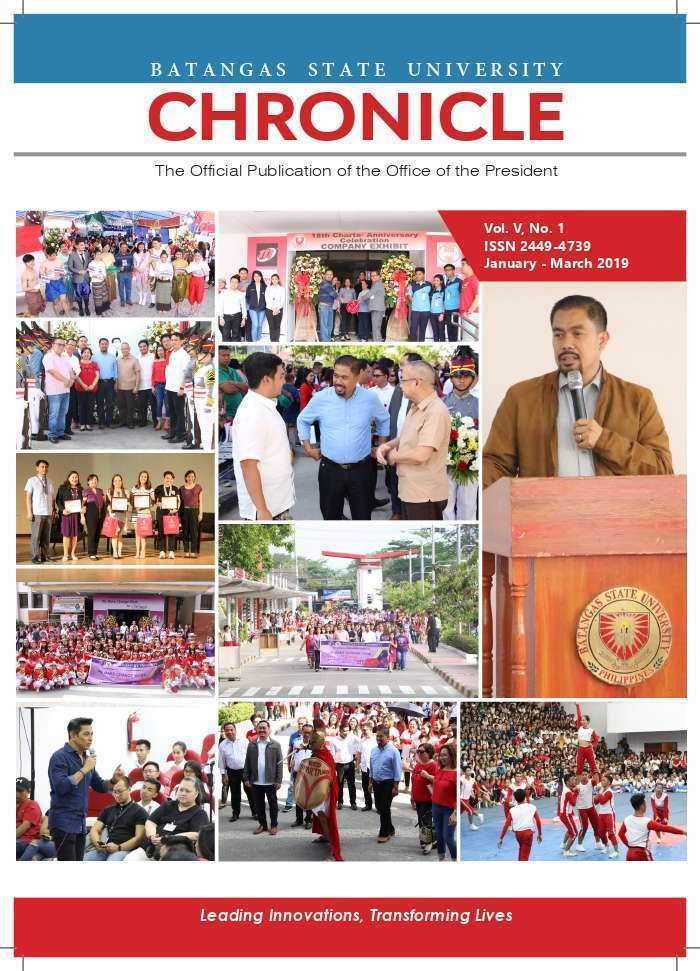
BatStateU Chronicle Vol. V, No. 1, January – March 2019