

Teacher Education
Home / Page Teacher Education The university’s Teacher Education program is designated by the Commission on Higher Education as a national Center of Development. The university remains to be one of the largest producers of licensed professional teachers and educational leaders and supervisors in the region. The teacher education program offerings focus on teaching pedagogies, curriculum development, assessment of learning, instructional materials development, 21st century education, virtual learning, and other emerging trends in different fields of specialization. Programs Offered Doctor of Education in Educational Management Doctor of Philosophy in Educational Management Doctor of Philosophy in Mathematics Education Master of Arts in Education: Major in Educational Management (Thesis/ Non-Thesis Program) Major in Mathematics Teaching Major in Science Teaching Major in English Language Teaching Major in Filipino Language Teaching Major in Physical Education Major in Psychology Major in Social Studies Teaching Major in Technology and Livelihood Education Teaching Bachelor of Elementary Education Bachelor of Early Childhood Education Bachelor of Secondary Education: Major in Science Major in English Major in Filipino Major in Mathematics Major in Social Studies Bachelor of Technology & Livelihood Education: Major in Home Economics Bachelor of Technical-Vocational Teacher Education: Major in Garments, Fashion and Design Major in Electronics Technology Bachelor of Physical Education BatStateU-Pablo Borbon Graduate ProgramsDoctor of Education in Educational ManagementDoctor of Philosophy in Educational ManagementDoctor of Philosophy in Mathematics EducationMaster of Arts in Education major in Educational ManagementMaster of Arts in Education major in English Language TeachingMaster of Arts in Education major in Mathematics TeachingMaster of Arts in Education major in Science TeachingMaster of Arts in Education major in Pagtuturo ng FilipinoMaster of Arts in Education major in PsychologyMaster of Arts in Education major in Physical EducationMaster of Arts in Education major in Social Studies TeachingMaster of Arts in Education major in Technology and Livelihood Education Teaching Undergraduate ProgramsBachelor of Elementary EducationBachelor of Early Childhood EducationBachelor of Secondary Education major in EnglishBachelor of Secondary Education major in MathematicsBachelor of Secondary Education major in SciencesBachelor of Secondary Education major in FilipinoBachelor of Secondary Education major in Social StudiesBachelor of Physical EducationBachelor of Technology and Livelihood Education major in Home Economics BatStateU-Rosario Undergraduate Programs Bachelor of Secondary Education major in EnglishBachelor of Secondary Education major in MathematicsBachelor of Technology and Livelihood Education major in: Home EconomicsBachelor of Elementary Education BatStateU-San Juan Undergraduate Programs Bachelor of Secondary Education major in EnglishBachelor of Secondary Education major in FilipinoBachelor of Technology and Livelihood Education BatStateU-Lemery Undergraduate Programs Bachelor of Technical-Vocational Teacher Education major in Garments, Fashion and DesignBachelor of Technical-Vocational Teacher Education major in Electronics TechnologyBachelor of Secondary Education major in Social Studies BatStateU-JPLPC Malvar Undergraduate Programs Bachelor of Secondary Education major in EnglishBachelor of Secondary Education major in SciencesBachelor of Secondary Education major in MathematicsBachelor of Secondary Education major in FilipinoBachelor of Secondary Education major in Social StudiesBachelor of Elementary EducationBachelor of Physical Education BatStateU-ARASOF Nasugbu Undergraduate Programs Bachelor of Elementary EducationBachelor of Physical EducationBachelor of Secondary Education major in EnglishBachelor of Secondary Education major in SciencesBachelor of Secondary Education major in MathematicsBachelor of Secondary Education major in FilipinoBachelor of Secondary Education major in Social Studies BatStateU-Lipa Undergraduate Programs Bachelor of Secondary Education major in EnglishBachelor of Secondary Education major in SciencesBachelor of Secondary Education major in Mathematics
College of Architecture, Fine Arts and Design
Alangilan Administration Students Faculty Research Extension Linkages Facilities Alangilan Administration Students Faculty Research Extension Linkages Facilities Home / Page College of Architecture, Fine Arts and Design The College of Architecture, Fine Arts and Design Program Educational Objectives of Architecture The Architecture alumni three to five years after graduation shall:1. Be knowledgeable of the comprehensive architectural services, both in theory and practice.2. Address the needs and demands of society and integrates himself to the social, economic,cultural and environmental aspects of nation building;3. Practice the basic philosophy and the fundamental principles of the multi-dimensionalaspects of architecture, understanding of the direct relationship between man and itsenvironment4. Adhere to professional, moral and ethical standards in the practice of Architecture. Program Educational Objectives of Interior DesignThe interior design alumni three to five years after graduation shall:1. Successfully demonstrate critical and analytical thinking of principles, philosophies andtheoretical frameworks of the Interior Design discipline.2. Foster a strong sense of nationalism arising from the realization of the role of interiordesign in the nation’s historical and cultural development.3. Adhere to professional, moral and ethical standards in the practice of Interior Design.development. Program Educational Objectives of Fine Arts major in Visual CommunicationThe fine arts major in visual communication alumni three to five years after graduation shall:1. Effectively practice the use of art and design devices in developing communicationcampaigns through traditional and non-traditional media2. Be a recognized professional in advertising industry and in creative media and marketingAdhere to professional and ethical practice in art, design and management College History College Figures Accreditation Curriculum Undergraduate Programs Description & Curriculum Bachelor of Fine Arts and Design Major in Visual Communication Bachelor of Science in Architecture Bachelor of Science in Interior Design Undergraduate Programs Description & Curriculum Master in Urban Planning and Design
College of Engineering Technology
Alangilan Administration Students Faculty Research Extension Linkages Facilities Alangilan Administration Students Faculty Research Extension Linkages Facilities Home / Page College of Engineering Technology The College of Engineering Technology is the first college established in the university, and has since proven to be a premier producer of well-rounded and globally competitive professionals who meet local, national, and international demands for skilled workers who significantly contribute to the manpower resources in response to the rapid industrialization of the modern world. CET Goal The College of Engineering Technology shall produce well-rounded and globally competitive individuals who meet local, national, and international demands for skilled workers. CET Objectives To devise up-to-date curricula that help attain goals, meet changing requirements, and reflect changes in Engineering Technology. To facilitate quality technical-vocational education and training towards the holistic competency and proficiency of individuals in the different technology areas. To mold individuals whose personal, social, technical, and practical qualities make them productive and valuable citizens of a global village. To train technologists in the use of applied research by innovating ways to address needs and problems and by implementing and extending current technology. College History College Figures Accreditation Curriculum A Legacy of Innovation: The Story of BatStateU – College of Engineering Technology More than a century ago, in 1903, Batangas State University began its journey as a Manual Training School with a focused mission: to provide young men with practical skills for gainful employment, particularly in the field of woodworking. Under the leadership of its first American principal, Mr. Sheer, the school laid the foundation for what would become a transformative force in technical and vocational education in the region. The school’s operations were interrupted by World War II, but its spirit endured. In 1945, it reopened, driven by a renewed commitment to education. Two years later, in 1947, vocational courses for girls were introduced, reflecting the school’s evolving inclusivity and expanding role in society. By 1953, the institution was renamed the Pablo Borbon Memorial Trade School in honor of Don Pablo Borbon, a distinguished Batangueño leader. Its growing contribution to industrial manpower in the province led to its elevation as the Pablo Borbon Memorial Regional School of Arts and Trades through Republic Act 4760. In 1963, the school began offering opportunity classes for unemployed and out-of-school youth in trades such as Automotive, Machine Shop Practice, Electricity, Radio Mechanics, Cosmetology, and Dressmaking—programs that directly empowered individuals and addressed community needs. Progress did not stop there. In 1978, under the guidance of Dr. Mariano O. Albayalde, then Dean of Instruction, the school launched a three-year Industrial Technician Education curriculum patterned after the Manila Technician Institute. This would later evolve into the Diploma of Technology, aligning with the Technical-Vocational Education Project of the Department of Education, Culture and Sports (DECS). These changes marked the institution’s shift toward a more formalized and comprehensive technical education pathway. A significant milestone was reached in 1983 when the school acquired a three-hectare site in Brgy. Alangilan, Batangas City, spearheaded by then-college president Mr. Isabelo Evangelio. This new campus would soon become the heart of its engineering and technology programs, beginning with the construction of the College for Industrial Technology (CIT) building. As the nation advanced into the era of modernization, so too did the institution. In the late 1990s, a range of advanced engineering technology programs was introduced, including Civil, Computer, Drafting, and Electronics Engineering Technology, as well as specialized fields such as Instrumentation and Control, Mechatronics, Petroleum, and Shipbuilding and Offshore Engineering Technology. Recognizing its academic evolution and broader scope, the institution underwent a formal change in academic identity. From its roots as a Manual Training School, it evolved into the College of Industrial Technology. By virtue of Board of Regents (BOR) Resolution No. 160, Series of 2023, it was subsequently renamed the College of Engineering Technology (CET), a name that better reflects its expanded vision and specialized focus. This transformation was accompanied by the shift from a singular Bachelor of Industrial Technology degree with 11 majors into 11 distinct Bachelor of Engineering Technology (BET) programs, namely Automotive Engineering Technology, Civil Engineering Technology, Computer Engineering Technology, Drafting Engineering Technology, Food Engineering Technology, Instrumentation and Control Engineering Technology, Electrical Engineering Technology, Electronics Engineering Technology, Mechanical Engineering Technology, Mechatronics Engineering Technology, and Welding and Fabrication Engineering Technology – each recognized as independent disciplines. This transition was solidified through BOR Resolution No. 158, Series of 2023, while the approval of these programs was affirmed through BOR Resolution No. 159, Series of 2023. All three resolutions were officially passed on December 19, 2023, marking a defining moment in the College’s history. At present, CET remains at the forefront of higher technical education, committed to excellence and innovation. It continues to enrich the knowledge and skills of its students through advanced facilities, industry partnerships, and initiatives such as the Dual Training System (DTS)—ensuring that its graduates are prepared not just for employment but for leadership in the dynamic world of engineering and technology. From its humble beginnings to its current status as a regional leader in engineering and technology education, the College has remained true to its mission: to shape competent, ethical, and globally competitive professionals equipped to meet the demands of the 21st century and beyond. Master of Technology Name of Accrediting Agency Title of Accreditation Validity Commission on Higher Education (CHED) CHED Certificate of Program Compliance (COPC) COPC No. 127, S. 2024 CEB RESO NO. 599-2024 Effective AY 2024–2025 Accrediting Agency of Chartered Colleges and Universities in the Philippines (AACCUP) Level II Re-accredited Dec. 1, 2021 – Nov. 30, 2025 Doctor of Technology Name of Accrediting Agency Title of Accreditation Validity Commission on Higher Education (CHED) CHED Certificate of Program Compliance (COPC) COPC No. 126, S. 2024 CEB RESO NO. 599-2024 Effective AY 2024–2025 Accrediting Agency of Chartered Colleges and Universities in the Philippines (AACCUP) Level II Re-accredited Dec. 1, 2021 – Nov. 30, 2025 Undergraduate Programs Name of Accrediting Agency Title of Accreditation Validity Accrediting Agency of Chartered Colleges and Universities in the
College of Engineering
Alangilan Administration Students Faculty Research Extension Linkages Facilities Alangilan Administration Students Faculty Research Extension Linkages Facilities Home / Page College of Engineering The College of Engineering at Batangas State University, The National Engineering University (BatStateU The NEU), is a recognized leader in engineering education, known for producing topnotchers and globally competitive graduates. With a strong foundation in innovation, sustainability, and nation-building, the college fully implements outcomes-based education and integrates technopreneurship into its curricula to equip students with 21st-century skills. Several programs hold prestigious designations from the Commission on Higher Education (CHED), with Electronics Engineering named a Center of Excellence, and Electrical and Mechanical Engineering recognized as Centers of Development. The College of Engineering at Batangas State University, The National Engineering University (BatStateU The NEU), is a recognized leader in engineering education, known for producing topnotchers and globally competitive graduates. With a strong foundation in innovation, sustainability, and nation-building, the college fully implements outcomes-based education and integrates technopreneurship into its curricula to equip students with 21st-century skills. Several programs hold prestigious designations from the Commission on Higher Education (CHED), with Electronics Engineering named a Center of Excellence, and Electrical and Mechanical Engineering recognized as Centers of Development. Notably, BatStateU is the first state university in the country with ABET-accredited programs in BS Chemical, Civil, Computer, Electrical, Electronics, Industrial, Mechanical, and Sanitary Engineering—accredited by the Engineering Accreditation Commission (EAC) of US-based ABET, under both the General and Program Criteria, and by the Philippine Technological Council’s ACBET. CoE Goal To produce globally competitive, innovative, and socially responsible engineers committed to excellence, sustainability, and national development. CoE Objectives Deliver Quality Education: Provide outcomes-based and industry-aligned engineering programs that develop technical expertise, critical thinking, and problem-solving skills. Foster Innovation and Research: Encourage research, development, and innovation that address real-world challenges and contribute to technological advancement. Promote Ethical and Responsible Practice: Instill values of professionalism, integrity, and social responsibility in all engineering disciplines. Support Lifelong Learning and Leadership: Develop future leaders through continuous learning, leadership training, and community engagement. Strengthen Industry and Global Linkages: Build strong partnerships with industry, government, and academic institutions to enhance learning, employment, and research opportunities. College History College Figures Accreditation Curriculum Blueprint of Excellence: The College of Engineering Through the Years As the country’s National Engineering University, the College of Engineering at Batangas State University stands as a testament to the Philippines’ pursuit of excellence in innovation, with a rich history marked by continuous growth and transformative development. The college traces its roots back to 1985, when it was established as the Engineering Department, laying the foundation for engineering education at the university. In 1992, it was renamed simply as Engineering, signifying its emergence as a distinct academic unit. By 1997, with the introduction of architecture programs, the college expanded and became the College of Engineering and Architecture (CEA). In 2000, the institution broadened its academic portfolio to include fine arts, adopting the name College of Engineering, Architecture and Fine Arts (CEAFA). This growth continued in 2006 with the inclusion of computing sciences, prompting another renaming as the College of Engineering, Architecture, Fine Arts, and Computing Sciences (CEAFACS). However, in 2013, the college returned to the title College of Engineering, Architecture and Fine Arts (CEAFA), reflecting a refined focus on its core disciplines. Most recently, in 2022—following Batangas State University’s designation as the Philippines’ National Engineering University—the college embraced a streamlined identity as the College of Engineering (COE), reinforcing its leadership role in shaping the future of engineering education in the country. This dynamic evolution underscores the college’s adaptability, resilience, and steadfast commitment to addressing the ever-changing educational needs of its students and the broader community. Doctorate Programs Name of Accrediting Agency Title of Accreditation Validity Commission on Higher Education (CHED) CHED Certificate of Program Compliance (COPC) COPC No. 009, S. 2019 Effective AY 2019–2020 AACCUP Candidate for Level I September 16, 2024 – September 15, 2025 Commission on Higher Education (CHED) CHED Certificate of Program Compliance (COPC) COPC No. 249, S. 2023 CEB RESO NO. 738 – 2023 Effective AY 2023–2024 Commission on Higher Education (CHED) CHED Certificate of Program Compliance (COPC) COPC No. 147, S. 2024 CEB RESO NO. 718 – 2023 Effective AY 2023–2024 Commission on Higher Education (CHED) CHED Certificate of Program Compliance (COPC) COPC No. 095, S. 2023 CEB RESO NO. 294 – 2023 Effective AY 2022–2023 Master’s Programs Name of Accrediting Agency Title of Accreditation Validity Commission on Higher Education (CHED) CHED Certificate of Program Compliance (COPC) COPC No. 37, S. 2021 Effective AY 2020–2021 AACCUP Level III Re-accredited March 16, 2025 – March 15, 2029 Commission on Higher Education (CHED) CHED Certificate of Program Compliance (COPC) COPC No. 010, S. 2019 Effective AY 2019–2020 AACCUP Level II Re-accredited October 1, 2024 – September 30, 2025 Commission on Higher Education (CHED) CHED Certificate of Program Compliance (COPC) COPC No. 041, S. 2025 Effective AY 2024–2025 Master of Engineering – Major in Electronics Engineering CHED COPC No. 011, S. 2019 Effective AY 2019–2020 AACCUP Level II Re-accredited October 1, 2024 – September 30, 2025 Master of Engineering – Major in Electrical Engineering CHED COPC No. 012, S. 2019 Effective AY 2019–2020 AACCUP Level II Re-accredited October 1, 2024 – September 30, 2025 Master of Engineering – Major in Computer Engineering CHED COPC No. 042, S. 2020 Effective AY 2020–2021 AACCUP Level II Re-accredited October 1, 2024 – September 30, 2025 Master of Engineering – Major in Chemical Engineering CHED COPC No. 001, S. 2020 Effective AY 2020–2021 AACCUP Level II Re-accredited October 1, 2024 – September 30, 2025 Master of Engineering – Major in Civil Engineering CHED COPC No. 271, S. 2022 Effective AY 2022–2023 AACCUP Level II Re-accredited October 1, 2024 – September 30, 2025 Master of Engineering – Major in Industrial Engineering CHED COPC No. 097, S. 2023 Effective AY 2022–2023 AACCUP Level II Re-accredited October 1, 2024 – September 30, 2025 Master of Engineering – Major in Mechanical Engineering CHED COPC No. 272, S. 2022 Effective AY 2022–2023 AACCUP Level II
ETEEAP Applications for Midterm Intake is Now Open!
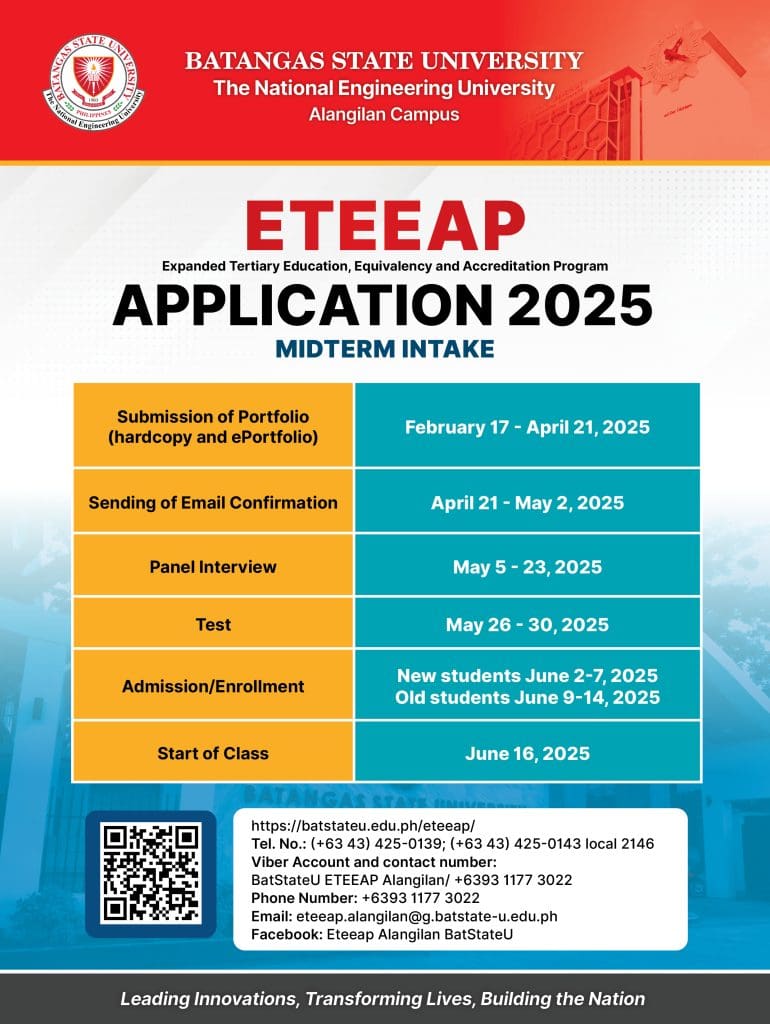
📢 ANNOUNCEMENT: ETEEAP Applications for Midterm Intake is Now Open at Batangas State University Alangilan Campus!🎓📚 Batangas State University, The National Engineering University Alangilan Campus is now accepting applications for the Expanded Tertiary Education Equivalency and Accreditation Program (ETEEAP) for the Academic Year 2025! If you have extensive work experience and want to earn a degree, this is your chance! Important Dates to Remember:Application Period: February 17 – April 21, 2025Email Confirmation: April 21 – May 2, 2025Panel Interview: May 5 – 23, 2025Examination Period: May 26 – 30, 2025Admission/Enrollment: *New Students: June 2 – 7, 2025 *Old Students: June 9 – 14, 2025Start of Classes: June 16, 2025 Program Offerings: • Bachelor of Science in Industrial Engineering• Bachelor of Science in Instrumentation and Control Engineering• Bachelor of Science in Computer Engineering• Bachelor of Science in Information Technology• Bachelor of Science in Computer Science• Bachelor in Industrial Technology with majors in:– Automotive Technology– Civil Technology– Electrical Technology– Mechanical Technology Don’t miss this opportunity. Prepare your documents and apply now! For more information, please visit or reach out through our contact details:🌐 Website: https://batstate-u.edu.ph/eteeap/📧 Email: eteeap.alangilan@g.batstate-u.edu.ph📞 Phone: (+63 43) 425-0139 (+63 43) 425-0143 (local 2146)📱 Viber: BatStateU ETEEAP Alangilan / +6393-1177-3022📱 Phone Number: +6393-1177-3022🤳 Facebook: Eteeap Alangilan BatStateU Join us in bridging the gap and empowering the industry workforce! #BatStateUETEEAP#LeadingInnovations#TransformingLives#BuildingtheNation
Bridge the Gap with BatStateU ETEEAP!
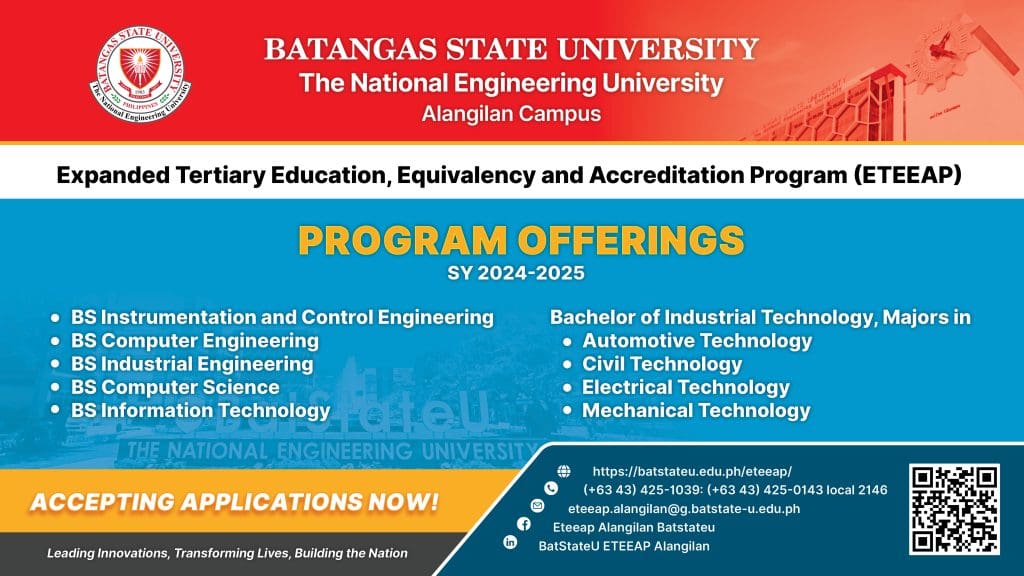
Ready to transform your work experience and skills into an accredited degree? Batangas State University, The National Engineering University (BatStateU The NEU), through its Expanded Tertiary Education Equivalency and Accreditation Program (ETEEAP), offers an accelerated pathway to earn a bachelor’s degree in engineering and today’s most in-demand fields. Earn the qualifications that propel your career and align with industry needs. 𝗣𝗿𝗼𝗴𝗿𝗮𝗺 𝗢𝗳𝗳𝗲𝗿𝗶𝗻𝗴𝘀:• Bachelor of Science in Industrial Engineering• Bachelor of Science in Instrumentation and Control Engineering• Bachelor of Science in Computer Engineering• Bachelor of Science in Information Technology• Bachelor of Science in Computer Science• Bachelor in Industrial Technology with majors in: – Automotive Technology – Civil Technology – Electrical Technology – Mechanical Technology Learn more and apply today!🌐 Website: https://batstate-u.edu.ph/eteeap/📧 Email: eteeap.alangilan@g.batstate-u.edu.ph📞 Phone: (+63 43) 425-0139; (+63 43) 425-0143 (local 2146)📱 Follow us for updates:Facebook: Eteeap Alangilan BatStateU | LinkedIn: BatStateU ETEEAP Alangilan Join us in Bridging the Gap and Empowering the Industry Workforce!Unlock the smart path to your degree NOW!#BatStateUETEEAP#LeadingInnovations#TransformingLives#BuildingtheNation
BatStateU ETEEAP Applications are now OPEN for 2025!
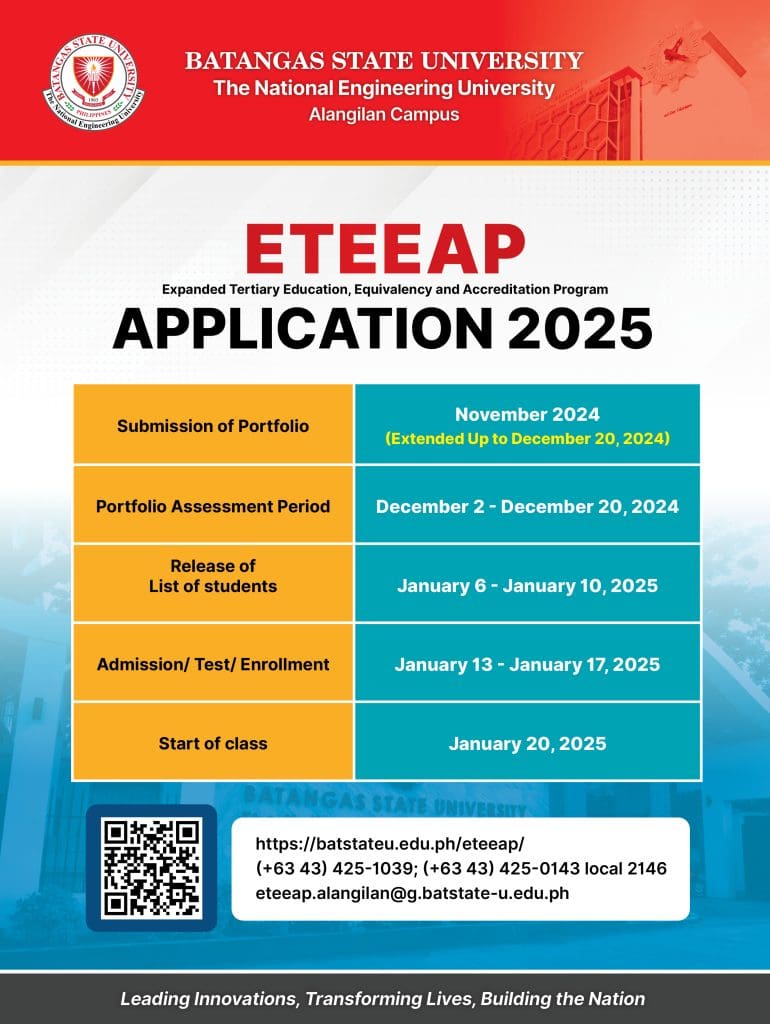
We are excited to announce that applications for Batangas State University, The National Engineering University’s (BatStateU The NEU) Expanded Tertiary Education Equivalency and Accreditation Program (ETEEAP) are now open! This is your opportunity to bridge the gap by turning your work experience and skills in engineering and other high-demand sectors into an accredited bachelor’s degree. 𝗘𝗧𝗘𝗘𝗔𝗣 𝗔𝗽𝗽𝗹𝗶𝗰𝗮𝘁𝗶𝗼𝗻 𝗧𝗶𝗺𝗲𝗹𝗶𝗻𝗲 𝗳𝗼𝗿 𝟮𝟬𝟮𝟱:• Portfolio Submission: November 2024 (Extended until December 20, 2024)• Portfolio Assessment Period: December 2 – December 20, 2024• Release of Qualified Students List: January 6 – January 10, 2025• Admission Test & Enrollment: January 13 – January 17, 2025• Classes Begin: January 20, 2025 𝗣𝗿𝗼𝗴𝗿𝗮𝗺 𝗢𝗳𝗳𝗲𝗿𝗶𝗻𝗴𝘀:• Bachelor of Science in Industrial Engineering• Bachelor of Science in Instrumentation and Control Engineering• Bachelor of Science in Computer Engineering• Bachelor of Science in Information Technology• Bachelor of Science in Computer Science• Bachelor in Industrial Technology (with majors in):– Automotive Technology– Civil Technology– Electrical Technology– Mechanical Technology For more information, please visit or reach out through our contact details below: 🌐 Website: https://batstate-u.edu.ph/eteeap/📧 Email: eteeap.alangilan@g.batstate-u.edu.ph📞 Phone: (+63 43) 425-0139; (+63 43) 425-0143 (local 2146)📱 Social Media:Facebook: Eteeap Alangilan BatStateULinkedIn: BatStateU ETEEAP Alangilan Join us in bridging the gap and empowering the industry workforce! 𝗧𝗮𝗸𝗲 𝘁𝗵𝗲 𝘀𝗺𝗮𝗿𝘁 𝗽𝗮𝘁𝗵 𝘁𝗼 𝘆𝗼𝘂𝗿 𝗱𝗲𝗴𝗿𝗲𝗲, 𝗔𝗣𝗣𝗟𝗬 𝗡𝗢𝗪!
IT Specialist Certification: Computer Networking Success at BatStateU
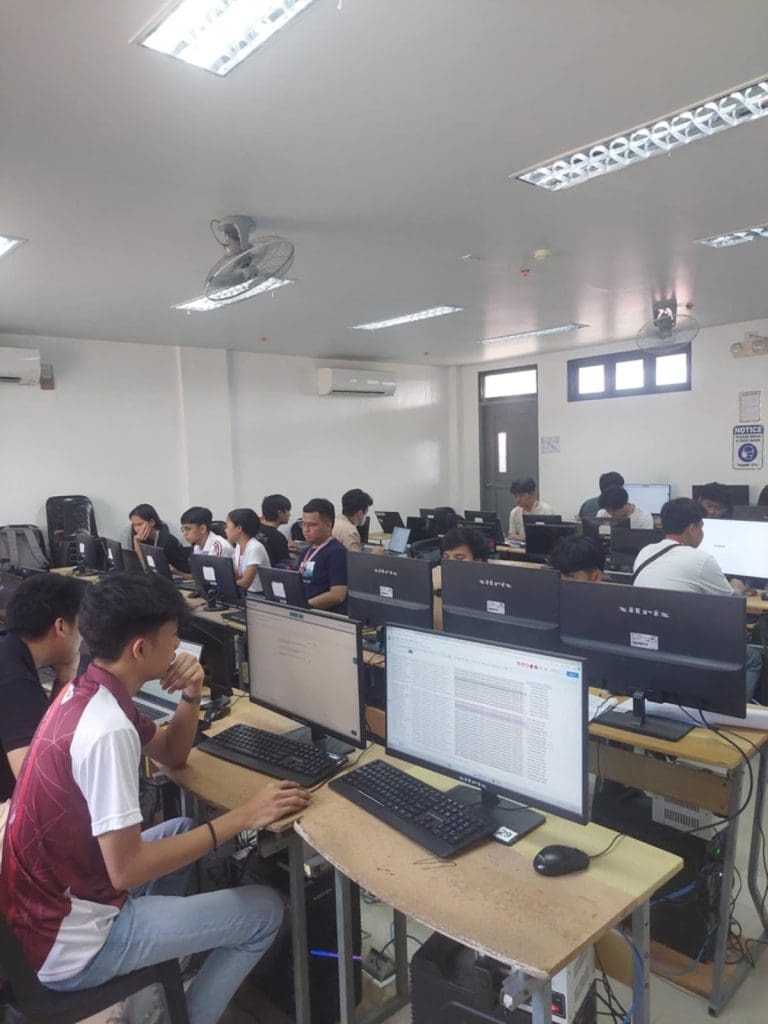
On May 9, 2024, Batangas State University (BatStateU) conducted the IT Specialist Certification in Computer Networking for students and faculties held at the CET Building’s Computer Laboratory 1 and 2.
CIEE Website
BatState-U CIEE Center for Innovation in Engineering Education Fueling Ingenuity and Leadership in Engineering Educationthrough MAJOR EVENTS Responsive About Section About Us The Center for Innovation in Engineering Education (CIEE) envisions to advance the quality of engineering education in order to develop academic and industry leaders in the global knowledge economy. CIEE aims to establish an engineering education hub that is committed to develop synergies within a community of interdisciplinary experts to further promote exchange of knowledge and resources from the university level to the industry sector or vice versa. The Center provides support to the engineering curriculum development as well as in achieving target areas in research, teaching, learning, and assessment pedagogies, professional training for capacity building and other Higher Education Institutions (HEI) needs. We also manage industry linkages and partnerships to foster developments in engineering education. CIEE also organizes international conferences in engineering education and manages the publishing of paper publications. Our Role “Transforming the Future of Engineering Education through Innovation.” Education Advancement and Excellence The Center supports the college through engineering curriculum development, assessment of graduate attributes, continuing professional growth, and continuous quality improvement (CQI). Partnerships, Linkages and Sustainability The Center manages industry linkages and partnership development, internationalization and global engagements. It also aims sustainable resource generation, scouting of grants, donation and endowment, and the establishment of a foundation. Professional Activities and Publications The Center manages the conduct of programs, events, and activities that support the academic and professional growth of students, teachers, and engineers. GOALS To fulfill its mandate of advancing engineering education and excellence, the CIEE has three (3) main objectives: 1. To provide support to the engineering curriculum development, assessment of graduate attributes, continuing professional development, teaching excellence recognition and awards, continuous quality improvement (CQI), selection and awarding of professorial chairs, mentoring of new engineering educators, spearheading research in engineering education, and direction setting to the college of engineering. It is also part of the objective to provide direction setting support to other HEIs. 2. To manage the partnership development, internationalization and global engagements, sustainable resource generation, scouting of grants, donation and endowment, and establishment of foundation. 3. To manage the conduct of conferences, technical exhibitions, and job fairs; as well as the publication of journals, magazines and newsletters, IEC (information, education and communication) materials, and digital content. “The Center for Innovation in Engineering Education provides opportunities for the university’s stakeholders to discover their potentials and enhance their technical and creative skills in a vibrant academic and research environment. Through pragmatic, innovation-driven activities anchored on industry-responsive programs, The CIEE builds on advanced knowledge and intellectual capital, which serve as the currency of the now and of the future… …so that its competitive advantage is acquired in the local and global workplace.” Dr. TIRSO A. RONQUILLO, ASEAN Eng. Batangas State University President Events and Conferences “Revolutionizing engineering education through innovation and collaboration!” All Competitons Event Conferences ASCENT’24 Conference ICIEE 2024 Conference WED 2024 Event Hackathon 2024 Competition ASCENT’23 Conference WED 2023 Event CDIO Workshop 2022 Event ASCENT’ 22 Conference WED 2022 Event Hackathon 2022 Competition ICIEE 2021 Conference SUEP 2021 Competition WED 2021 Event Our Publications “Innovate. Educate. Inspire: Discover the Latest in Engineering Education with Our Newsletter.” The Radial Volume I Q1 The Radial Volume I Q2 The Radial Volume II Q1 The Radial Volume II Q2 ASCENT 2022 Contact Us Location 3rd Floor, STEERHub Building, Batangas State University Alangilan Campus Batangas, Philippines 4200 E-Mail ciee@g.batstate-u.edu.phciee.secretariat@g.batstate-u.edu.ph Call +6343425-0143local 2411 Follow our Facebook Page To stay updated on our current Events, Conferences and Competitions Follow © Copyright Center for Innovation in Engineering Education. All Rights Reserved Designed by CIEE Development Team, KZ Maranan
Student Organizations Lipa
Lipa Supreme Student Council BatStateU- The NEU Lipa The highest independent student governing body of Batangas State University- The National Engineering University Lipa