

Data Management
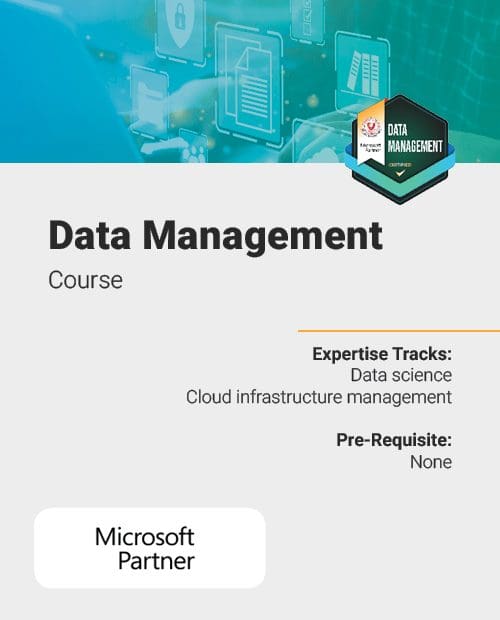
HOME REGISTER 23 HOURS ONLINE ENGLISH 20 HOURS HYBRID ENGLISH HOME REGISTER In this course, you will learn the basics of data concepts and how to use Microsoft Azure’s data services to manage them effectively. We will cover everything from relational and non-relational data, to big data and analytics, giving you a robust understanding of cloud data services available on Microsoft Azure. The course will guide you through the fundamentals of relational data and the database services offered by Azure. You’ll get to know how to work with non-relational data using Azure storage solutions and will be introduced to the capabilities of Azure Cosmos DB. Plus, we’ll shed light on large-scale data warehousing and how to make the most of real-time analytics and data visualization. This course is ideal for those who are looking to grasp database concepts in a cloud setting, and to gain a solid foundation in Microsoft Azure’s data services, whether you’re brushing up on basics or learning it all for the first time. What You’ll Learn At the end of this course, learners will be able to describe data concepts, roles, and services. They will also be adept at evaluating relational database service and non-relational data on Azure. Additionally, learners will be skilled in managing data analytics and visualization on Azure. Skills You’ll Gain Data Science Cloud Infrastructure Management Roles Database Administrator What You’ll Learn At the end of this course, learners will be able to describe data concepts, roles, and services. They will also be adept at evaluating relational database service and non-relational data on Azure. Additionally, learners will be skilled in managing data analytics and visualization on Azure. Skills You’ll Gain Data Science Cloud Infrastructure Management Roles Database Administrator Course Outline Module 1: Cloud Concepts Module 2: Azure Architecture and Services Module 3: Azure Management and Governance Module 4: Data Concepts Module 5: Relational Data Module 6: Non-relational Data Module 7: Data Analytics in Azure Reqired Resources Laptop, Intel Core i5 or higher, 16GB RAM, 1TB Storage, Graphics Card (Hardware); Microsoft Azure (Software); Adequate Internet Connection (Network) Pre-Requisites None Assessment In this Data Management course: One (1) diagnostic assessment is available, conducted synchronously and based on knowledge, with the flexibility for learners to choose between remote or on-site participation. Two (2) formative assessments are offered, one focusing on knowledge and the other on performance. Both are available asynchronously, allowing learners to complete them at their own pace, with the option for remote or on-site participation. A knowledge-based style summative assessment is scheduled to be conducted synchronously, providing learners with the choice of participating remotely or on-site. Credit and Recognition The learner is eligible to take the Microsoft Certified: Azure Fundamentals and Azure Data Fundamentals. This course is facilitated by a Microsoft Certified professional. To ensure the quality of this micro-credential, continuous feedback loops with students, instructors, and industry practitioners are maintained to continually improve content, delivery, and assessment methods. Learning Pathways Data Management is the foundational course for your journey in the world of data. Upon successful completion, you’ll have the choice to specialize further in:
Data Science
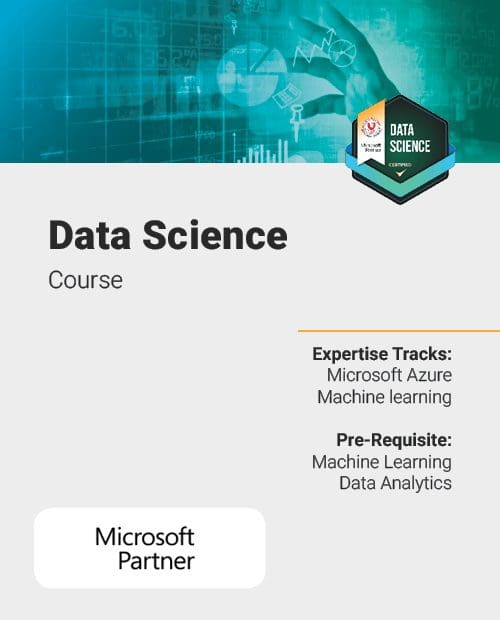
HOME REGISTER 46 HOURS ONLINE ENGLISH 46 HOURS ONLINE ENGLISH HOME REGISTER In this Data Science course, we will explore the vast field of machine learning leveraging the potential of Azure Machine Learning. Whether you’re building on your foundational knowledge of Python and machine learning or just getting started, this course will guide you through important aspects such as data ingestion, preparation, model training, and deployment. Plus, you’ll learn how to monitor machine learning solutions proficiently within the Microsoft Azure environment. It’s a course designed to give you the skills and knowledge to harness the full power of Azure in machine learning, helping you become proficient in data science. What You’ll Learn At the end of this course, learners will be able to describe what data science and machine learning are, including their applications & use cases, and the various types of tasks performed by data scientists. They will also be proficient in examining the Azure Machine Learning SDK tool. Furthermore, learners will be equipped to deploy, train, and analyze a model using Azure Machine Learning. Skills You’ll Gain Microsoft Azure Machine learning Roles Data Scientist AI Engineer What You’ll Learn At the end of this course, learners will be able to describe what data science and machine learning are, including their applications & use cases, and the various types of tasks performed by data scientists. They will also be proficient in examining the Azure Machine Learning SDK tool. Furthermore, learners will be equipped to deploy, train, and analyze a model using Azure Machine Learning. Skills You’ll Gain Microsoft Azure Machine learning Role Data Scientist AI Engineer Course Outline Module 1: Design a Machine Learning SolutionModule 2: Exploring Azure Machine LearningModule 3: Data Management in Azure MLModule 4: Working with Azure ML Compute ResourcesModule 5: No-Code Approaches in Azure MLModule 6: Automation in Model SelectionModule 7: Using Notebooks in Azure MLModule 8: Training Models using ScriptsModule 9: Optimization Techniques in Azure MLModule 10: Model Management TechniquesModule 11: Model Deployment and ConsumptionModule 12: Machine Learning Operations (MLOps) in Azure Required Resources Laptop, Intel Core i5 or higher, 16GB, 1TB Storage, Graphics Card (Hardware); Microsoft Azure (Software); Adequate Internet Connection (Network) Pre-Requisites This course is designed for data scientists with existing knowledge of Python and machine learning frameworks like Scikit-Learn, PyTorch, and Tensorflow, who want to build and operate machine learning solutions in the cloud. Assessment One (1) diagnostic assessment is available, conducted synchronously, and is knowledge-based, with the flexibility for learners to choose between remote or on-site participation. Two (2) formative assessments are offered, one focused on knowledge and the other on performance. Both are available asynchronously, allowing learners to complete them at their own pace, and learners have the option to participate remotely or on-site. A performance-based summative assessment is to be conducted synchronously, providing learners with the choice of remote or on-site participation. Credit and Recognition The learner is eligible to take the Microsoft Certified: Azure Data Scientist Associate. This course is facilitated by a Microsoft Certified professional. To ensure the quality of this micro-credential, continuous feedback loops with students, instructors, and industry practitioners are maintained to continually improve content, delivery, and assessment methods. Learning Pathways Data Science is the ultimate destination, and it can be reached through two distinct paths:Data Analytics: If you’re passionate about discovering actionable insights from data.Machine Learning: If you’re intrigued by the world of predictive modeling and artificial intelligence.
Data Engineering
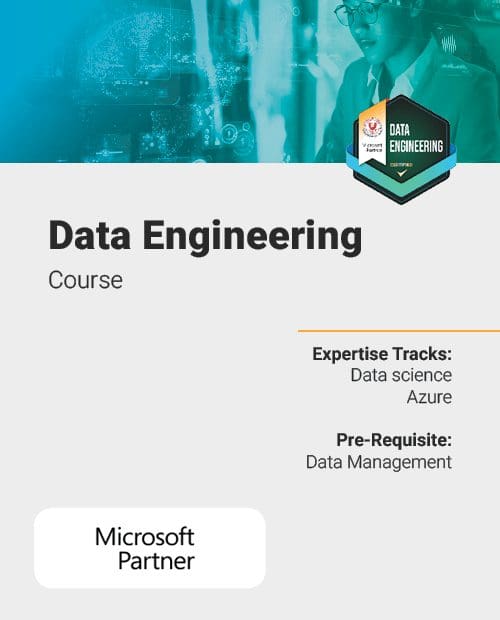
HOME REGISTER 32 HOURS ONLINE ENGLISH 65 HOURS ONLINE ENGLISH HOME REGISTER In this Data Engineering course, you will learn how to work with batch and real-time analytics solutions using the technology provided by the Azure data platform. The journey begins with understanding the core computing and storage technologies essential in building analytical solutions. You will discover how to explore data stored in data lakes interactively, using files as your guide. From there, we will cover the various techniques available for data ingestion using prominent tools such as Apache Spark in Azure Synapse Analytics or Azure Databricks, as well as Azure Data Factory or Azure Synapse pipelines. Not only will you learn how to bring data into your analytics systems, but you will also explore different methods to transform this data using the same ingestion tools. As we go further, we emphasize the critical role of security in protecting data whether it’s stored or being transferred. Towards the end, you will learn to create real-time analytics systems, opening doors to crafting solutions that work with data as it comes in, providing insights faster and more accurately. This course is designed to give you hands-on experience and a strong foundation in the fast-paced world of data engineering. What You’ll Learn At the end of this course, learners will be able to design and implement various stages and concepts in the data engineering lifecycle, including storage, processing, and security, in Microsoft Azure. Additionally, they will be capable of creating and performing data service operations, such as monitoring and optimization, in Microsoft Azure. Skills You’ll Gain Data science Azure Roles Data Engineer What You’ll Learn At the end of this course, learners will be able to design and implement various stages and concepts in the data engineering lifecycle, including storage, processing, and security, in Microsoft Azure. Additionally, they will be capable of creating and performing data service operations, such as monitoring and optimization, in Microsoft Azure. Skills You’ll Gain Data science Azure Role Data Engineer Course Outline Module 1: Get Started with Data Engineering on Azure Module 2: Build data analytics solutions using Azure Synapse serverless SQL pools Module 3: Perform data engineering with Azure Synapse Apache Spark Pools Module 4: Work with Data Warehouses using Azure Synapse Analytics Module 5: Transfer and transform data with Azure Synapse Analytics pipelines Module 6: Work with Hybrid Transactional and Analytical Processing Solutions using Azure Synapse Analytics Module 7: Implement a Data Streaming Solution with Azure Stream Analytics Module 8: Govern data across an enterprise Module 9: Data engineering with Azure Databricks Required Resources Laptop, Intel Core i5 or higher, 16GB, 1TB Storage, Graphics Card (Hardware); Microsoft Azure (Software); Adequate Internet Connection (Network) Pre-Requisites The primary audience for this course is data professionals, data architects, and business intelligence professionals who want to learn about data engineering and building analytical solutions using data platform technologies that exist on Microsoft Azure. The secondary audience for this course are data analysts and data scientists who work with analytical solutions built on Microsoft Azure. Assessment One (1) diagnostic assessment is available, conducted synchronously and is knowledge-based, with the flexibility for learners to choose between remote or on-site participation. Two (2) formative assessments are offered, one focused on knowledge and the other on performance. Both are available asynchronously, allowing learners to complete them at their own pace, and learners have the option to participate remotely or on-site. A performance-based summative assessment is to be conducted synchronously, providing learners with the choice of remote or on-site participation. Credit and Recognition The learner is eligible to take the Microsoft Certified: Azure Data Engineer Associate. This course is facilitated by a Microsoft Certified professional. To ensure the quality of this micro-credential, continuous feedback loops with students, instructors, and industry practitioners are maintained to continually improve content, delivery, and assessment methods. Learning Pathways Data Management is your prerequisite for entering the world of Data Engineering, where you’ll learn how to architect and manage data pipelines efficiently. Data Engineering is an essential step toward mastering Machine Learning.
Machine Learning

HOME REGISTER 19 HOURS ONLINE ENGLISH 19 HOURS ONLINE ENGLISH HOME REGISTER In this Machine Learning course, we will equip you with a strong foundation in the critical concepts and practical skills needed to work with classical machine learning models. The journey begins with understanding the core principles, supported by a healthy balance of theoretical knowledge and hands-on exercises to grasp various machine learning techniques and their practical applications. You’ll become adept at preprocessing and analyzing data, building resilient models, and evaluating their performance to make informed, data-driven decisions. Suitable for both beginners and those looking to build on their existing knowledge, this course aims to empower you with the competencies required to tackle real-world challenges effectively using classical machine learning models. What You’ll Learn At the end of this course, learners will be able to demonstrate a comprehensive understanding of the fundamental concepts, principles, and techniques of machine learning. They will also be equipped to apply their knowledge of machine learning to real-world scenarios. Furthermore, they will develop the ability to critically analyze and evaluate machine learning models, synthesize their knowledge and skills to construct and refine these models, and evaluate the effectiveness and performance of machine learning models. Skills You’ll Gain Microsoft Azure Machine learning Roles Data Scientist AI Engineer What You’ll Learn At the end of this course, learners will be able to demonstrate a comprehensive understanding of the fundamental concepts, principles, and techniques of machine learning. They will also be equipped to apply their knowledge of machine learning to real-world scenarios. Furthermore, they will develop the ability to critically analyze and evaluate machine learning models, synthesize their knowledge and skills to construct and refine these models, and evaluate the effectiveness and performance of machine learning models. Skills You’ll Gain Microsoft Azure Machine learning Role Data Scientist AI Engineer Course Outline Module 1: Introduction to Data for Machine LearningModule 2: Explore and Analyze Data with PythonModule 3: Train and Understand Regression Models in Machine LearningModule 4: Refine and Test Machine Learning ModelsModule 5: Train and Evaluate Regression ModelsModule 6: Create and Understand Classification Models in Machine LearningModule 7: Customize Architectures and Hyperparameters Using Random ForestModule 8: Confusion Matrix and Data ImbalancesModule 9: Optimize Model Performance with ROC and AUCModule 10: Train and Evaluate Classification ModelsModule 11: Train and Evaluate Clustering ModelsModule 12: Train and Evaluate Deep Learning Models Required Resources Laptop, Intel Core i5 or higher, 16GB, 1TB Storage, Graphics Card (Hardware); Microsoft Azure (Software); Adequate Internet Connection (Network) Pre-Requisites This course is designed for data scientists with existing knowledge of Python and machine learning frameworks like Scikit-Learn, PyTorch, and Tensorflow, who want to build and operate machine learning solutions in the cloud. Assessment In this Machine Learning course: One (1) diagnostic assessment is available, conducted synchronously, and is knowledge-based, with the flexibility for learners to choose between remote or on-site participation. Two (2) formative assessments are offered, one focused on knowledge and the other on performance. Both are available asynchronously, allowing learners to complete them at their own pace, and learners have the option to participate remotely or on-site. A performance-based summative assessment is to be conducted synchronously, providing learners with the choice of remote or on-site participation. Credit and Recognition Upon successful completion of the Machine Learning course, learners will receive a Certificate of Completion. This certificate serves both as a recognition of acquired expertise in machine learning and as a foundational step toward more advanced studies in the field of Data Science. This course is facilitated by a Microsoft Certified professional. To ensure the quality of this micro-credential, continuous feedback loops with students, instructors, and industry practitioners are maintained to continually improve content, delivery, and assessment methods. Learning Pathways Your journey into Machine Learning begins with either Data Engineering or Data Management. This foundational knowledge will equip you with the skills needed to explore the exciting field of Machine Learning, which, in turn, opens doors to the broader field of Data Science.
Data Analytics
HOME REGISTER 26 HOURS ONLINE ENGLISH 42 HOURS ONLINE ENGLISH HOME REGISTER In this Data Analytics course, you’ll dive deep into learning the best strategies and techniques for working with data using Power BI, a powerful tool that meets both business and technical needs. You’ll learn how to handle data from a range of sources, both relational and non-relational, and how to visualize and analyze that data to make informed decisions. We’ll also cover the essential skills needed to manage, deploy, and share reports and dashboards, promoting effective collaboration among teams. Whether you’re working with a business or on a technical project, this course equips you with the knowledge to leverage Power BI in optimizing data analysis and reporting processes. What You’ll Learn At the end of this course, learners will be able to prepare and organize data for analysis. They will also be equipped to develop analytical skills, encompassing data cleaning, analysis, and visualization, using Power BI. Furthermore, learners will be proficient in creating and managing workspaces and datasets in Power BI. Skills You’ll Gain Data analysis Azure Power BI Roles Data Analyst What You’ll Learn At the end of this course, learners will be able to prepare and organize data for analysis. They will also be equipped to develop analytical skills, encompassing data cleaning, analysis, and visualization, using Power BI. Furthermore, learners will be proficient in creating and managing workspaces and datasets in Power BI. Skills You’ll Gain Data analysis Azure Power BI Role Data Analyst Course Outline Module 1: Microsoft Data Analytics Module 2: Prepare Data for Analysis Module 3: Model Data in Power BI Module 4: Visualize Data in Power BI Module 5: Data Analysis in Power BI Module 6: Manage Workspaces and Datasets in Power BI Reqired Resources Laptop, Intel Core i5 or higher, 16GB, 1TB Storage, Graphics Card (Hardware); Microsoft Power BI (Software); Adequate Internet Connection (Network) Pre-Requisites The audience for this course are data professionals and business intelligence professionals who want to learn how to accurately perform data analysis using Power BI. This course is also targeted toward those individuals who develop reports that visualize data from the data platform technologies that exist both in the cloud and on-premises. Assessment In this Data Analytics course: One (1) diagnostic assessment is available, conducted synchronously, and focuses on knowledge-based testing. Learners have the flexibility to choose between remote or on-site participation. Two (2) formative assessments are offered, one concentrating on knowledge and the other on performance-based skills measurement. Both formative assessments are available asynchronously, allowing learners to complete them at their own pace, with the option of remote or on-site participation. A summative assessment in Data Analytics is centered on performance-based skills evaluation. This summative assessment is to be conducted synchronously, giving learners the choice of participating remotely or on-site. Credit and Recognition The learner is eligible to take the Microsoft Certified: Power BI Data Analyst Associate. This course is facilitated by a Microsoft Certified professional. To ensure the quality of this micro-credential, continuous feedback loops with students, instructors, and industry practitioners are maintained to continually improve content, delivery, and assessment methods. Learning Pathways Data Analytics Path: Data Management serves as your starting point on the path to becoming a skilled Data Analyst. This path ultimately leads to a broader understanding of data through Data Science.