

Machine Learning

HOME REGISTER 19 HOURS ONLINE ENGLISH 19 HOURS ONLINE ENGLISH HOME REGISTER In this Machine Learning course, we will equip you with a strong foundation in the critical concepts and practical skills needed to work with classical machine learning models. The journey begins with understanding the core principles, supported by a healthy balance of theoretical knowledge and hands-on exercises to grasp various machine learning techniques and their practical applications. You’ll become adept at preprocessing and analyzing data, building resilient models, and evaluating their performance to make informed, data-driven decisions. Suitable for both beginners and those looking to build on their existing knowledge, this course aims to empower you with the competencies required to tackle real-world challenges effectively using classical machine learning models. What You’ll Learn At the end of this course, learners will be able to demonstrate a comprehensive understanding of the fundamental concepts, principles, and techniques of machine learning. They will also be equipped to apply their knowledge of machine learning to real-world scenarios. Furthermore, they will develop the ability to critically analyze and evaluate machine learning models, synthesize their knowledge and skills to construct and refine these models, and evaluate the effectiveness and performance of machine learning models. Skills You’ll Gain Microsoft Azure Machine learning Roles Data Scientist AI Engineer What You’ll Learn At the end of this course, learners will be able to demonstrate a comprehensive understanding of the fundamental concepts, principles, and techniques of machine learning. They will also be equipped to apply their knowledge of machine learning to real-world scenarios. Furthermore, they will develop the ability to critically analyze and evaluate machine learning models, synthesize their knowledge and skills to construct and refine these models, and evaluate the effectiveness and performance of machine learning models. Skills You’ll Gain Microsoft Azure Machine learning Role Data Scientist AI Engineer Course Outline Module 1: Introduction to Data for Machine LearningModule 2: Explore and Analyze Data with PythonModule 3: Train and Understand Regression Models in Machine LearningModule 4: Refine and Test Machine Learning ModelsModule 5: Train and Evaluate Regression ModelsModule 6: Create and Understand Classification Models in Machine LearningModule 7: Customize Architectures and Hyperparameters Using Random ForestModule 8: Confusion Matrix and Data ImbalancesModule 9: Optimize Model Performance with ROC and AUCModule 10: Train and Evaluate Classification ModelsModule 11: Train and Evaluate Clustering ModelsModule 12: Train and Evaluate Deep Learning Models Required Resources Laptop, Intel Core i5 or higher, 16GB, 1TB Storage, Graphics Card (Hardware); Microsoft Azure (Software); Adequate Internet Connection (Network) Pre-Requisites This course is designed for data scientists with existing knowledge of Python and machine learning frameworks like Scikit-Learn, PyTorch, and Tensorflow, who want to build and operate machine learning solutions in the cloud. Assessment In this Machine Learning course: One (1) diagnostic assessment is available, conducted synchronously, and is knowledge-based, with the flexibility for learners to choose between remote or on-site participation. Two (2) formative assessments are offered, one focused on knowledge and the other on performance. Both are available asynchronously, allowing learners to complete them at their own pace, and learners have the option to participate remotely or on-site. A performance-based summative assessment is to be conducted synchronously, providing learners with the choice of remote or on-site participation. Credit and Recognition Upon successful completion of the Machine Learning course, learners will receive a Certificate of Completion. This certificate serves both as a recognition of acquired expertise in machine learning and as a foundational step toward more advanced studies in the field of Data Science. This course is facilitated by a Microsoft Certified professional. To ensure the quality of this micro-credential, continuous feedback loops with students, instructors, and industry practitioners are maintained to continually improve content, delivery, and assessment methods. Learning Pathways Your journey into Machine Learning begins with either Data Engineering or Data Management. This foundational knowledge will equip you with the skills needed to explore the exciting field of Machine Learning, which, in turn, opens doors to the broader field of Data Science.
Networking Essentials
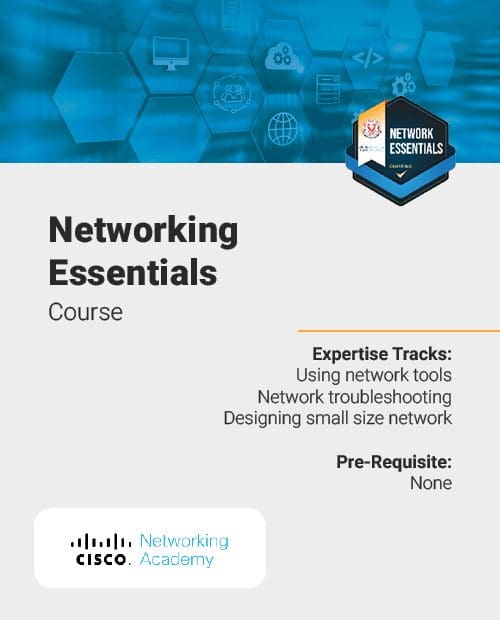
HOME REGISTER 40 HOURS HYBRID ENGLISH 40 HOURS HYBRID ENGLISH HOME REGISTER In the Networking Essentials course, you’ll be introduced to the fundamental principles and practices of computer networking. We’ll start with the basics, such as understanding network architecture, protocols, topologies, and how to secure a network. From there, we will explore different types of networks including local area networks (LANs), wide area networks (WANs), and even the internet itself. You will learn about the key protocols and technologies that allow devices to connect and communicate, diving into topics such as Ethernet, TCP/IP, and DNS. But it’s not just about theory; we’ll give you hands-on experience in network administration and troubleshooting, teaching you how to handle devices like routers and switches and how to solve network issues as they arise. By the end of this course, you’ll have a solid foundation in networking essentials, with the know-how to manage and maintain various network environments. What You’ll Learn At the end of this course, learners will be able to explain the purpose of common networking protocols and technologies. They will also be skilled in configuring and managing network devices, such as routers and switches. Additionally, learners will be adept at using network troubleshooting tools and techniques to diagnose and resolve network issues. Skills You’ll Gain Using network tools Network troubleshooting Designing small size network Roles Network Technician Network Engineer Network Administrator What You’ll Learn At the end of this course, learners will be able to explain the purpose of common networking protocols and technologies. They will also be skilled in configuring and managing network devices, such as routers and switches. Additionally, learners will be adept at using network troubleshooting tools and techniques to diagnose and resolve network issues. Skills You’ll Gain Using network tools Network troubleshooting Designing small size network Role Network Technician Network Engineer Network Administrator Course Outline Module 1: Internet Connection Module 2: Network Protocols and Architecture Module 3: Data Communications and Network Services Module 4: Home/Office Network Basics Module 5: Network Configuration Reqired Resources Laptop or PC, Windows 10, 4GB RAM or higher, Adequate Internet Connection (Network); CISCO Packet Tracer 8.0 or later (Software) Pre-Requisites A basic understanding of computer systems and internet browsing, or any courses related to Computer Fundamentals. Assessment One (1) diagnostic assessment is available, conducted asynchronously, and is knowledge-based, with the flexibility for learners to choose between remote or on-site participation. A performance-based formative assessment is offered, conducted synchronously. Learners have the option to participate remotely or on-site. A performance-based summative assessment is to be conducted synchronously, and learners can choose between remote or on-site participation. Credit and Recognition Learners are eligible to take the CISCO Certification, the certification is globally recognized wherever Cisco and Cisco NetAcad are acknowledged. This course is delivered in partnership with CISCO Networking Academy. To ensure the quality of this micro-credential, continuous feedback loops with students, instructors, and industry practitioners are maintained to continually improve content, delivery, and assessment methods. Learning Pathways Under the Junior Cybersecurity Analyst Pathway, Networking Essentials serves as the foundational course. It lays the groundwork for your journey into the world of cybersecurity, specifically in the domain of Endpoint Security.
Cybersecurity Network Defense
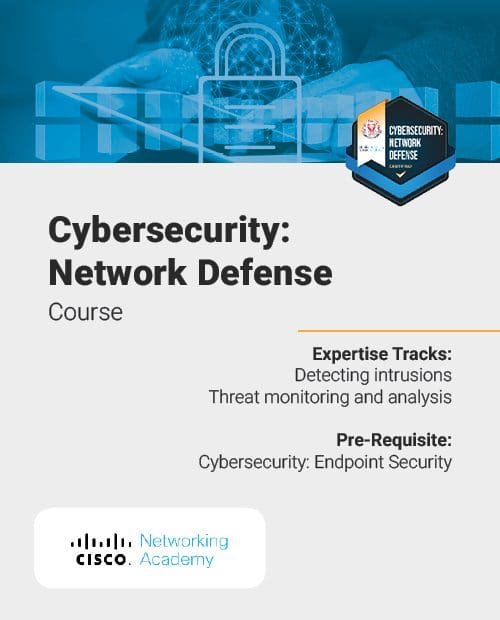
HOME REGISTER 40 HOURS HYBRID ENGLISH 40 HOURS HYBRID ENGLISH HOME REGISTER In the “Cybersecurity: Network Defense” course, you will embark on a journey to understand the vital aspects of cybersecurity, including how to defend systems and networks effectively. We cover a broad spectrum of topics such as access control, the functioning and application of firewalls, ensuring security in the cloud environment, and the practical applications of cryptography. Moreover, we delve into understanding network security data and how to evaluate security alerts proficiently. Throughout the course, you will have hands-on experiences that will empower you to set defensive measures in place, manage access controls, work with simulated firewalls, and make sense of various kinds of network data. By the end, you will be adept at assessing security alerts, equipped with the skills to be a line of defense in the ever-evolving landscape of cybersecurity. What You’ll Learn At the end of this course, learners will be able to implement various aspects of system and network defense. They will also be skilled in configuring local and server-based access control. Furthermore, learners will be equipped to recommend cloud security requirements based on a given cloud scenario, and they will be proficient in using different types of logs and records to store information regarding hosts and the network. Skills You’ll Gain Detecting Intrusions Threat Monitoring and Analysis Roles Cybersecurity Officer Cybersecurity Analyst Network Analyst What You’ll Learn At the end of this course, learners will be able to implement various aspects of system and network defense. They will also be skilled in configuring local and server-based access control. Furthermore, learners will be equipped to recommend cloud security requirements based on a given cloud scenario, and they will be proficient in using different types of logs and records to store information regarding hosts and the network. Skills You’ll Gain Detecting Intrusions Threat Monitoring and Analysis Role Cybersecurity Officer Cybersecurity Analyst Network Analyst Course Outline Module 1: Understanding Defense Module 2: System and Network Defense Module 3: Access Control Module 4: Access Control Lists Module 5: Firewall Technologies Module 6: Zone-Based Policy Firewalls Module 7: Cloud Security Module 8: Cryptography Module 9: Technologies and Protocols Module 10: Network Security Data Module 11: Evaluating Alerts Required Resources Computer, 2GB RAM or higher, 8GB free disk space (Hardware); Oracle VirtualBox and virtual machine image file (Software); High-speed Internet Connection (Network) Pre-Requisites PC and internet navigation skills, basic Windows and Linux system concepts, basic understanding of computer networks, and binary and hexadecimal conversion; completed course Cybersecurity: Endpoint Security Assessment In this Cybersecurity: Endpoint Security course: One (1) diagnostic assessment is available, to be conducted asynchronously, and will be knowledge-based, allowing learners to proceed at their own pace. It offers the flexibility for remote or on-site participation. A performance-based formative assessment is to be offered, to be conducted synchronously, allowing learners to choose between remote or on-site participation. A performance-based summative assessment is to be conducted synchronously, providing learners with the option of remote or on-site participation. Credit and Recognition Learners are eligible to take the CISCO Certification “Cybersecurity: Threat Management”, and the certification is globally recognized wherever Cisco and Cisco NetAcad are acknowledged. The course is delivered in partnership with CISCO Networking Academy and aligns with CISCO-Certified Support Technician (CCST) Cybersecurity certification. To ensure the quality of this micro-credential, continuous feedback loops with students, instructors, and industry practitioners are maintained to continually improve content, delivery, and assessment methods. Learning Pathways Cybersecurity: Network Defense Cybersecurity: Endpoint Security is a prerequisite for Cybersecurity: Network Defense. After mastering the fundamentals of endpoint security, you’ll be ready to delve deeper into network defense strategies as part of the Junior Cybersecurity Analyst Pathway.
Cybersecurity: Endpoint Security

HOME REGISTER 40 HOURS HYBRID ENGLISH 40 HOURS HYBRID ENGLISH HOME REGISTER In the Cybersecurity: Endpoint Security course, you’ll begin with the foundational principles of cybersecurity, setting the stage to understand the common threats, vulnerabilities, and risks prevalent in today’s digital landscape. As we delve deeper, we’ll cover the nuances of different network protocol vulnerabilities and service vulnerabilities, with special emphasis on Windows and Linux endpoints. The course not only brings you face-to-face with the current trends and possible attacks but also equips you to counter these threats effectively through mitigation and defense strategies. By the end of your journey, you will have a rounded understanding of cybersecurity, capable of identifying prevalent threats and dissecting common attacks. Whether it’s understanding the critical concepts of endpoint operations and security or analyzing malware intricacies, this course has got you covered, preparing you to navigate the cyber world safely and confidently. What You’ll Learn At the end of this course, learners will be able to explain the threats, vulnerabilities, and attacks that occur in the various domains. They will also be competent in recommending basic threat mitigation measures. Furthermore, learners will be adept at using malware investigation tools to understand malware features and will be proficient in evaluating endpoint protection and the impacts of malware. Skills You’ll Gain Detecting intrusions Threat monitoring and analysis Roles Cybersecurity Officer Network Administrator What You’ll Learn At the end of this course, learners will be able to explain the threats, vulnerabilities, and attacks that occur in the various domains. They will also be competent in recommending basic threat mitigation measures. Furthermore, learners will be adept at using malware investigation tools to understand malware features and will be proficient in evaluating endpoint protection and the impacts of malware. Skills You’ll Gain Detecting intrusions Threat monitoring and analysis Role Cybersecurity Officer Network Administrator Course Outline Module 1: Introduction to Cybersecurity Module 2: Cybersecurity Threats, Vulnerabilities, and Attacks Module 3: Securing Networks Module 4: Attacking the Foundation Module 5: Attacking What We Do Module 6: Wireless Network Communication Devices Module 7: Network Security Infrastructure Module 8: The Windows Operating System Module 9: Linux Overview Module 10: System and Endpoint Protection Module 11: Cybersecurity Principles, Practices, and Processes Required Resources Computer, 2GB RAM or higher, 8GB free disk space (Hardware); Oracle VirtualBox, Packet Tracer 8.0.1 or higher (Software); High-speed Internet Connection (Network) Pre-Requisites PC and internet navigation skills, basic understanding of computer networks, and knowledge of TCP/IP networking including network protocols, services, and processes; completed course Cybersecurity: Network Defense Assessment One (1) diagnostic assessment is available, conducted asynchronously, and is knowledge-based, allowing learners to proceed at their own pace. It offers the flexibility for remote or on-site participation. A performance-based formative assessment is offered, conducted synchronously, allowing learners to choose between remote or on-site participation. A performance-based summative assessment is to be conducted synchronously, providing learners with the option of remote or on-site participation. Credit and Recognition Learners are eligible to take the CISCO Certification “Cybersecurity: Network Defense”, the certification is globally recognized wherever Cisco and Cisco NetAcad are acknowledged. This course is delivered in partnership with CISCO Networking Academy. To ensure the quality of this micro-credential, continuous feedback loops with students, instructors, and industry practitioners are maintained to continually improve content, delivery, and assessment methods. Learning Pathways Networking Essentials is a prerequisite for Cybersecurity: Endpoint Security. Upon successfully completing this course, you’ll be prepared to advance to the next step in the Junior Cybersecurity Analyst Pathway.
IoT – Internet of Things: Connecting Things
HOME REGISTER 20 HOURS HYBRID ENGLISH 20 HOURS HYBRID ENGLISH HOME REGISTER In the “IoT – Internet of Things: Connecting Things” course, you’ll dive deep into the fundamental concepts that drive the Internet of Things (IoT). You’ll start by exploring the core reasons behind the move to connect everything, identifying what exactly can be connected, and learning the strategies to establish this extensive connectivity. The journey will take you through the workings of a typical IoT solution which encompasses sensors, local analytic capabilities, network connections, and the skills to analyze the collected data effectively. You will learn to enhance products, processes, or businesses through detailed instrumentation and data collection, starting from an end-to-end connection from a sensor to a gateway, all the way to networks and the cloud. Moreover, the course guides you in pinpointing problems solvable by IoT and helps you design an IoT system precisely catered to solve those issues. It is a comprehensive approach to understanding and utilizing IoT in real-world scenarios. What You’ll Learn At the end of this course, learners will be able to design circuits and develop microcontroller programs using Arduino with various components. They will also be proficient in developing Python programs on the Raspberry Pi to enable IoT functionality. Additionally, learners will be adept at utilizing Packet Tracer to simulate Python-integrated IoT systems and will be equipped to construct business models using the Business Model Canvas. They will also understand the applications of IoT in sectors like healthcare, energy, smart-city, and manufacturing. Furthermore, learners will recognize the significance of designing secure IoT solutions that safeguard devices, software, and data. Skills You’ll Gain Python programming for IoT IoT system design Roles IoT Developer IoT Product Manager What You’ll Learn At the end of this course, learners will be able to design circuits and develop microcontroller programs using Arduino with various components. They will also be proficient in developing Python programs on the Raspberry Pi to enable IoT functionality. Additionally, learners will be adept at utilizing Packet Tracer to simulate Python-integrated IoT systems and will be equipped to construct business models using the Business Model Canvas. They will also understand the applications of IoT in sectors like healthcare, energy, smart-city, and manufacturing. Furthermore, learners will recognize the significance of designing secure IoT solutions that safeguard devices, software, and data. Skills You’ll Gain Python programming for IoT IoT system design Roles IoT Developer IoT Product Manage Course Outline Module 1: Things and Connections Module 2: Sensors, Actuators, and Microcontrollers Module 3: Software is Everywhere Module 4: Fog Networks and Cloud Services Module 5: Industrial IoT Applications Module 6: Create an IoT Solution Required Resources Microsoft Windows or Mac OS (Software); Prototyping Lab Application, Cisco Packet Tracer 7.1 or later (Software); Raspberry Pi 3 CanaKit Ultimate Starter Kit, Sparkfun Inventor’s Kit for Arduino – V3.2, Multicolored Jumper Wires (40-pin Male to Female, 40-pin Male-to-Male, 40-pin Female-to-Female), Breadboard Jumper Wires (Hardware). Pre-Requisites Basic Python programming skills and foundational knowledge in networking and electronics Assessment In this IoT: Big Data and Analytics course: One (1) diagnostic assessment is available, to be conducted synchronously and is knowledge-based, with the flexibility for learners to choose between remote or on-site participation. A performance-based summative assessment is to be conducted synchronously, offering learners the option of participating remotely or on-site. Two (2) formative assessments are offered, both concentrating on performance-based skills measurement and to be conducted synchronously. Learners have the option to participate remotely or on-site. Credit and Recognition This Fundamental Course is a stackable pre-requisite for the Hackathon Playbook and IoT Security, and the certification is globally recognized wherever Cisco and Cisco NetAcad are acknowledged. This course is delivered in partnership with CISCO Networking Academy. To ensure the quality of this micro-credential, continuous feedback loops with students, instructors, and industry practitioners are maintained to continually improve content, delivery, and assessment methods. Learning Pathways “IoT – Internet of Things: Connecting Things” requires prior completion of “IoT – Internet of Things: Big Data and Analytics.” This prerequisite ensures that you have the foundational knowledge needed for a smooth and successful progression in your IoT education.
Mastering GIS Basics with ArcGIS
HOME REGISTER 24 HOURS FACE-TO-FACE ENGLISH In the Mastering GIS Basics with ArcGIS course, you will come to grips with the fundamental concepts of geographic data and GIS technology. This course is crafted to take you on a journey where you’ll learn how to use GIS maps to bring real-world features to your fingertips, enabling you to visualize and explore them in depth. But it doesn’t stop there; you’ll delve into data analysis to extract valuable insights and learn how to share these maps, data, and other vital resources across your organization. The course encapsulates essential workflows, tools, and techniques pivotal in GIS, offering you hands-on experience through practical exercises. By the end of this immersive learning experience, you will have honed the skills needed to navigate and utilize GIS technology effectively, ready to apply them in real-world scenarios. What You’ll Learn At the end of this course, learners will be able to manage spatial information by creating, updating, and organizing data using Geographic Information System (GIS) software. They will also be skilled in displaying features on a GIS map accurately and accessing its information efficiently. Additionally, learners will be adept at employing standard workflows to analyze GIS data and address spatial challenges. Furthermore, they will be equipped to design GIS map layouts and web maps to visualize data and disseminate analysis results. Skills You’ll Gain Creating GIS based maps GIS data management Roles GIS Technician Basic GIS User Course Outline Module 1: The Basics of GIS Module 2: Understanding Geographic Data Module 3: Visualizing Data Module 4: Labeling Features Module 5: Working with Tabular Data Module 6: Creating and Editing Data Module 7: Evaluating Data for Analysis Module 8: Solving Spatial Problems Module 9: Designing Map Layouts Module 10: Sharing Geographic Information Required Resources i-series or equivalent processor, 8GB RAM, 1GB video card, 500GB available hard disk, 15” monitor or dual display (Hardware); Windows 10 or higher (Software); Internet connection of speed 5 Mbps or faster (Network) Pre-Requisites At least a High School or Senior High School Graduate Assessment Practical Assessment: Hands-on activities are prepared for this course to assess the attainment of learning outcomes Final Assessment: This exam measures your ability to create, modify, and manage a structural project using Revit Structures Credit and Recognition This Basic GIS course is offered in collaboration with Geodata Systems Technologies, Inc., the exclusive Esri distributor in the Philippines, and is affiliated with certifying entities such as Logotri-Philnet of the Local Government Academy, the Civil Service Commission, and the Philippine Society for Training and Development (PSTD). It is stackable and serves as a prerequisite for the Advanced GIS Micro-credential Program. This course is in developed and delivered in collaboration with Geodata Systems Technologies, Inc. To ensure the quality of this micro-credential, continuous feedback loops with students, instructors, and industry practitioners are maintained to continually improve content, delivery, and assessment methods. Learning Pathways This course is the foundational cornerstone of your journey into the world of Geographic Information Systems (GIS). It equips you with the essential skills and knowledge required to grasp the basics of GIS, setting the stage for your exploration of more advanced GIS concepts and applications.
Cybersecurity: Cyber Threat Management
HOME REGISTER 32 HOURS HYBRID ENGLISH 32 HOURS HYBRID ENGLISH HOME REGISTER In the “Cybersecurity: Cyber Threat Management” course, you will dive into the fundamental concepts essential in the field of cybersecurity. We kick things off with ethics and governance before moving onto practical skills such as network security testing and endpoint vulnerability assessment. Throughout the course, we maintain a strong focus on critical aspects like threat intelligence and risk management, equipping you with the knowledge to respond effectively post-incident. Our goal is to prepare you to effectively engage in threat management and incident response activities, becoming a valuable member of a cybersecurity operations team. By the end of the course, you’ll have the skills and confidence to play a pivotal role in managing cyber threats, standing on the front lines of defense in the ever-vital field of cybersecurity. What You’ll Learn At the end of this course, learners will be able to use commands to gather network information and diagnose connectivity issues. They will also be proficient in explaining how endpoint vulnerabilities are assessed and managed. Furthermore, learners will be adept at evaluating security controls based on organization characteristics, and they will be equipped to apply various standards in incident handling procedures to a given incident scenario. Skills You’ll Gain Detecting intrusions Threat monitoring and analysis Roles IoT Developer IoT Project Manager What You’ll Learn At the end of this course, learners will be able to use commands to gather network information and diagnose connectivity issues. They will also be proficient in explaining how endpoint vulnerabilities are assessed and managed. Furthermore, learners will be adept at evaluating security controls based on organization characteristics, and they will be equipped to apply various standards in incident handling procedures to a given incident scenario. Skills You’ll Gain Detecting intrusions Threat monitoring and analysis Roles Cyber Security Analyst Course Outline Module 1: Governance and ComplianceModule 2: Security AssessmentsModule 3: Threat IntelligenceModule 4: Endpoint Vulnerability AssessmentModule 5: Risk Management and Security ControlsModule 6: Digital Forensics and Incident Analysis and Response Required Resources Computer, 2GB RAM or higher, 8GB free disk space (Hardware); Oracle VirtualBox, Virtual Machine Image File (Software); High-speed Internet Connection (Network) Pre-Requisites PC and internet navigation skills, basic Windows and Linux system concepts, and a basic understanding of computer network protocols, services, processes, and configurations; completed course Cybersecurity: Network Defense Assessment In this Cybersecurity: Cyber Threat Management course: One (1) diagnostic assessment is available, to be conducted asynchronously and will be knowledge-based, allowing learners to proceed at their own pace. It offers the flexibility for remote or on-site participation. Two (2) formative assessments are offered, one concentrating on knowledge and the other on performance-based skills measurement. Both formative assessments are to be conducted synchronously, giving learners the choice of participating remotely or on-site. A performance-based summative assessment is to be conducted synchronously, offering learners the option of remote or on-site participation. Credit and Recognition The certification is globally recognized wherever Cisco and Cisco NetAcad are acknowledged. The course is delivered in partnership with CISCO Networking Academy and aligns with CISCO-Certified Support Technician (CCST) Cybersecurity certification. To ensure the quality of this micro-credential, continuous feedback loops with students, instructors, and industry practitioners are maintained to continually improve content, delivery, and assessment methods. Learning Pathways Cybersecurity: Network Defense is a prerequisite for Cybersecurity: Cyber Threat Management. Upon successfully completing this course, you will have successfully completed the Junior Cybersecurity Analyst Pathway, equipping you with the skills and knowledge needed for a career in cybersecurity.
Data Analytics
HOME REGISTER 26 HOURS ONLINE ENGLISH 42 HOURS ONLINE ENGLISH HOME REGISTER In this Data Analytics course, you’ll dive deep into learning the best strategies and techniques for working with data using Power BI, a powerful tool that meets both business and technical needs. You’ll learn how to handle data from a range of sources, both relational and non-relational, and how to visualize and analyze that data to make informed decisions. We’ll also cover the essential skills needed to manage, deploy, and share reports and dashboards, promoting effective collaboration among teams. Whether you’re working with a business or on a technical project, this course equips you with the knowledge to leverage Power BI in optimizing data analysis and reporting processes. What You’ll Learn At the end of this course, learners will be able to prepare and organize data for analysis. They will also be equipped to develop analytical skills, encompassing data cleaning, analysis, and visualization, using Power BI. Furthermore, learners will be proficient in creating and managing workspaces and datasets in Power BI. Skills You’ll Gain Data analysis Azure Power BI Roles Data Analyst What You’ll Learn At the end of this course, learners will be able to prepare and organize data for analysis. They will also be equipped to develop analytical skills, encompassing data cleaning, analysis, and visualization, using Power BI. Furthermore, learners will be proficient in creating and managing workspaces and datasets in Power BI. Skills You’ll Gain Data analysis Azure Power BI Role Data Analyst Course Outline Module 1: Microsoft Data Analytics Module 2: Prepare Data for Analysis Module 3: Model Data in Power BI Module 4: Visualize Data in Power BI Module 5: Data Analysis in Power BI Module 6: Manage Workspaces and Datasets in Power BI Reqired Resources Laptop, Intel Core i5 or higher, 16GB, 1TB Storage, Graphics Card (Hardware); Microsoft Power BI (Software); Adequate Internet Connection (Network) Pre-Requisites The audience for this course are data professionals and business intelligence professionals who want to learn how to accurately perform data analysis using Power BI. This course is also targeted toward those individuals who develop reports that visualize data from the data platform technologies that exist both in the cloud and on-premises. Assessment In this Data Analytics course: One (1) diagnostic assessment is available, conducted synchronously, and focuses on knowledge-based testing. Learners have the flexibility to choose between remote or on-site participation. Two (2) formative assessments are offered, one concentrating on knowledge and the other on performance-based skills measurement. Both formative assessments are available asynchronously, allowing learners to complete them at their own pace, with the option of remote or on-site participation. A summative assessment in Data Analytics is centered on performance-based skills evaluation. This summative assessment is to be conducted synchronously, giving learners the choice of participating remotely or on-site. Credit and Recognition The learner is eligible to take the Microsoft Certified: Power BI Data Analyst Associate. This course is facilitated by a Microsoft Certified professional. To ensure the quality of this micro-credential, continuous feedback loops with students, instructors, and industry practitioners are maintained to continually improve content, delivery, and assessment methods. Learning Pathways Data Analytics Path: Data Management serves as your starting point on the path to becoming a skilled Data Analyst. This path ultimately leads to a broader understanding of data through Data Science.
Filipino engineering students sweep top awards at 2025 AAPG Sustainable Development Competition in USA
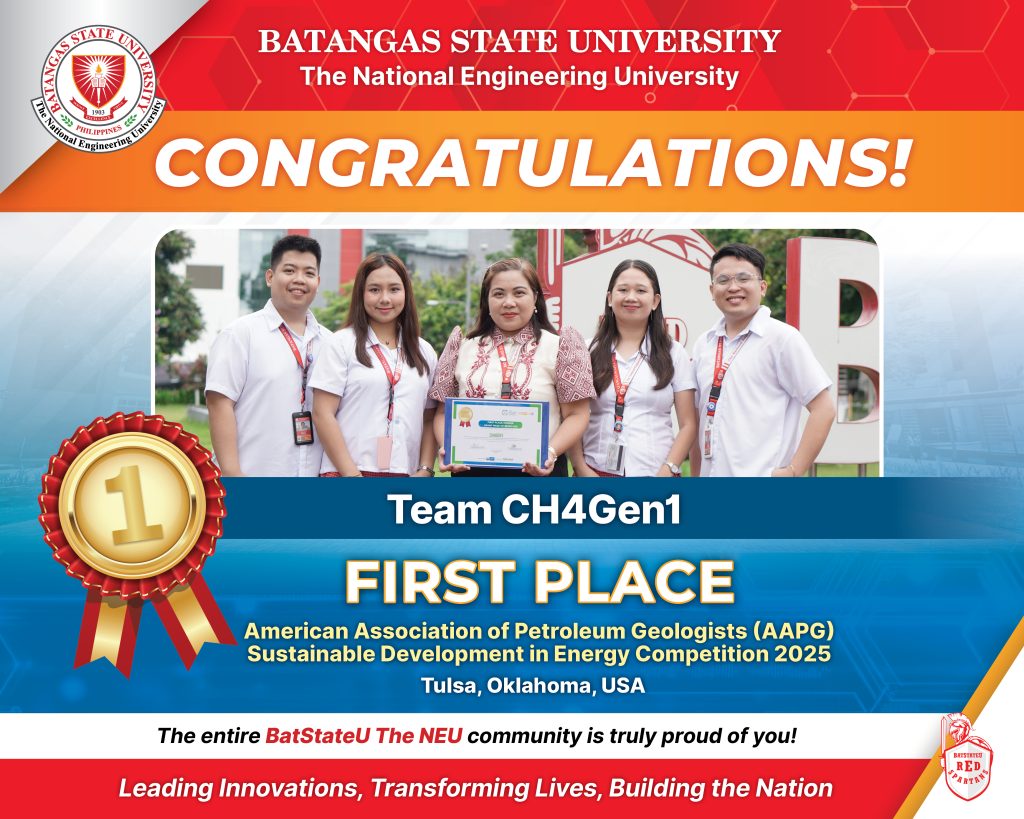
Team CH4GEN1, composed of BS Chemical Engineering students from Batangas State University, The National Engineering University (BatStateU The NEU), proudly raised the Philippine flag as they bagged multiple awards at the prestigious 2025 American Association of Petroleum Geologists (AAPG) Sustainable Development in Energy Competition (SDEC), held virtually in Tulsa, Oklahoma, USA on June 19. This historic victory marks the Philippines’ first-ever win in the competition, a significant milestone for both BatStateU The NEU, and the country. The winning team’s innovation, the Modular & Mobile Food Waste Digester for Biomethane and Biofertilizer Generation, clinched the 1st Place Grand Prize and secured a $5,000 award. The 2025 SDEC, which launched on January 30, drew 38 proposals from across the globe, with 10 finalists selected from countries including Colombia, Mexico, Malawi, India, Indonesia, and the Philippines. The competition culminated in a 10-week Venture Lab program, where finalists received coaching, collaborated with industry experts, and refined their innovative ideas. The journey led to the final pitch presentations held on June 19, 2025, where Team CH4GEN1 dominated, sweeping the awards with the Top Place Proposal Award, Precision Partner Award, and Voice of the Lab Award. Team CH4GEN1 triumphed in the competition, surpassing other exceptional teams, including Juan David Palma Montealegre from Colombia, who secured 2nd place with his project on ‘Eggshells for Sustainable Mining,’ and Team Energon from India, which claimed 3rd place for their work on ‘Biomass Valorization.’ Team CH4GEN1 led by MJ Rivera, Joshua Angue, Kayla De Torres, and Nessa Lane Latonio, alongside their mentor Assoc. Prof. Rhonalyn V. Maulion delivered a groundbreaking project: the mobile and modular food waste digester. This innovative system converts household and community food scraps into clean biomethane for energy and biofertilizer for agriculture, delivering environmental benefits, economic savings, and a vision for a circular future. “This victory showcases the ingenuity and determination of our students at BatStateU and underscores the Philippines’ rising prominence in global innovation,” shared University President Dr. Tirso A. Ronquillo. “With achievements like the CH4GEN1 project, we are empowering the next generation of innovators to develop real-world solutions that drive sustainable development and make a global impact,” he added. The AAPG SDEC attracts global talent, with proposals spanning critical energy sectors such as oil and gas, as well as renewable energy solutions like solar, wind, and biomass. Finalists’ projects this year were rigorously evaluated based on originality, sustainability, applicability, and their social and environmental impact. Hosted by the AAPG Headquarters in Oklahoma, USA, and sponsored by the AAPG Foundation and Chevron, the competition provides students and young professionals with a platform to develop ethical, innovative, and sustainable solutions for energy challenges. Team CH4GEN1’s success will continue to inspire future innovators, as their pioneering work on the food waste digester aims to make a tangible impact on communities worldwide, offering a sustainable and efficient method for waste-to-energy conversion. Batangas State University, designated as the Philippines’ National Engineering University through Republic Act No. 11694, is widely recognized for its excellence in engineering education. A Level-IV state university, it has produced over 180 engineering board topnotchers, solidifying its reputation as the country’s largest engineering university. Notably, BatStateU is also a pioneer in quality assurance for engineering education. It is the first state university in the Philippines to have engineering programs accredited by the Philippine Technological Council through its Accreditation and Certification Board for Engineering and Technology (PTC-ACBET). Moreover, it remains the first—and to date, the only—state university in the country with engineering and computing programs accredited by the US-based Accreditation Board for Engineering and Technology (ABET) through both its Engineering Accreditation Commission (EAC) and Computing Accreditation Commission (CAC). BatStateU has earned global recognition for its commitment to sustainability. In the 2025 Times Higher Education (THE) Impact Rankings, the University ranked between 401-600 globally, reinforcing its leadership in addressing the United Nations’ Sustainable Development Goals (SDGs). Additionally, BatStateU was ranked as the 304th Most Sustainable University in the 2024 UI GreenMetric World University Rankings and recognized as the 128th Most Innovative University in the 2024 World University Rankings for Innovation (WURI). For more information about the competition, you can visit this link.
BatStateU KIST Park unveils Ventures Hub to shape the next innovation economy

Batangas State University (BatStateU), the Philippines’ National Engineering University, is taking bold strides toward the future of innovation, research, and industry-academe collaboration with the inauguration of the highly anticipated Knowledge, Innovation and Science Technology (KIST) Park’s Ventures Hub. Launched on June 19, 2025, this innovation space, located within BatStateU’s pioneering KIST Park, is set to transform the local startup ecosystem by turning visionary ideas into thriving ventures. The Ventures Hub offers modular locator spaces tailored to help startups grow and scale up. It empowers industry locators to collaborate, explore ideas, and seize opportunities in partnership with BatStateU. At the Ventures Hub, BatStateU’s commitment to innovation becomes action—delivering on the commitment of From Vision to Ventures. Its focus spans high-impact sectors such as semiconductors, electronics, artificial intelligence, agritech,healthtech, and more—reflecting the university’s commitment to advancing technologies that solve real-world problems. “Through initiatives like the Ventures Hub, we are ensuring that our students, researchers, and entrepreneurs have the tools, resources, and expertise to bring their ideas to life—creating solutions that resonate on a global scale. The Ventures Hub will empower the next generation of tech entrepreneurs and fuel economic growth by turning their visions into thriving businesses that will drive the Philippine economy forward,” shared Dr. Tirso A. Ronquillo, University President and Chief Operating Officer of BatStateU KIST Park, reflecting on KIST Park’s journey from its inception as a vision approved by the Board of Regents in 2016, to its declaration as a PEZA-registered Special Economic Zone in 2020, and now to its current status as it evolves into a reality. Central to the unique value proposition of BatStateU KIST Park is its access to BatStateU’s rich pool of talent, providing startups with world-class expertise, transformative research programs, and a dynamic ecosystem designed to foster innovation. This strategic partnership ensures that ventures can seamlessly transition from research and development to market-ready solutions, enhancing their global competitiveness. The inauguration ceremony kicked off with a ribbon-cutting event, followed by speeches from key stakeholders in the education and tech sectors, including Dr. Marita R. Canapi, Commissioner of the Commission on Higher Education (CHED); Dr. Napoleon K. Juanillo Jr., Assistant Secretary for Technology Transfer, Communications, and Commercialization (TTCC) of DOST; and Dir. Carmela P. Matabang, Regional Director of the Department of Economy, Planning and Development (DEPDev), Region IV-A. They all emphasized the importance of collaboration between industry and academe in advancing the country’s technology and innovation landscape. Startups and industry locators at Ventures Hub recognize the value of being part of an ecosystem where they are not building in isolation, but co-creating alongside researchers, students, and fellow innovators. The Ventures Hub provides the structure and support they need to move quickly, test ideas, and focus on building what truly matters. During the inauguration, existing industry locators, such as Plant Science Philippines Corporation, ParallaxED, TRIOE, Lycan Motorcycles, among others, participated in a unit exhibition showcasing their innovations, capabilities, and active role in shaping the vibrant, collaborative ecosystem within KIST Park. BatStateU KIST Park offers substantial government-backed incentives, including income tax holidays, VAT zero-rating, and streamlined business registration processes. These advantages reduce barriers to innovation, creating an ideal environment for startups to scale and succeed. BatStateU KIST Park, the first PEZA-registered Knowledge, Innovation, Science, and Technology (KIST) Park in the Philippines, is located in Alangilan, Batangas City. It serves as a hub for innovation, research, and industry-academe collaboration, designed to support tech-based startups and innovation-driven industry locators. The park provides purpose-built infrastructure and dynamic spaces like the Ventures Hub to help “Transform Knowledge into Technology.” For additional information about the Philippine’s First KIST visit: https://firstkistpark.com/